

Happy late summer, friends! Today I’m introducing Field Notes & Evidence, a revamped newsletter that will be home to those things that come across my desk that may be interesting, curious, or newsworthy, but which I can’t devote the time for a weeks-long, Fully-Told-style deep dive.
There are, after all, only so many weeks.
In fact, yesterday I calculated that if I live to be eighty years old, I’ve only got 1,040 weeks left—a number that suggests that there’s no time to waste and/or that I should get a job at the Internal Revenue Service. Because come on: 1040 weeks? What ... were ... the ... chances?
(SFX: Sound of crowd groaning, chairs scraping the floor, and a cascade of footsteps as people storm out of Uncle Yuk Yuk’s Comedy Hut, located in a strip mall outside Yuma.)
Spend enough time poking around public records, campaign-finance reports, government filings, meeting packets, court documents, and all the other places where important information hides in plain sight, you find things that should see the light of day but often never do.
Some of that is a consequence of the state of journalism today: fewer reporters, meager resources, and more things worth looking into than anyone can possibly get to.
The challenge is compounded by the fact that today’s journalists are often weak and sleepy, surviving as we do on little more than ramen noodles and mac-‘n’-cheese.
(Made-up statement from Kraft Foods: “Our macaroni-and-cheese provides convenient, affordable, delicious meal options that fit every budget.”)
Think of Field Notes & Evidence as a peek inside my notebook, where scribblings might include details of something previously unreported, brief updates on earlier stories, useful tidbits that may not justify an entire story, and random observations I’ve written down next to grocery lists and screenplay ideas and jokes ready to test out at my next Uncle Yuk Yuk’s gig.
Onward and/or upward,
Bill
P.S. Disclosure: Uncle Yuk Yuk is not a blood relation.
A.I. Finds the “Donate Now” Button
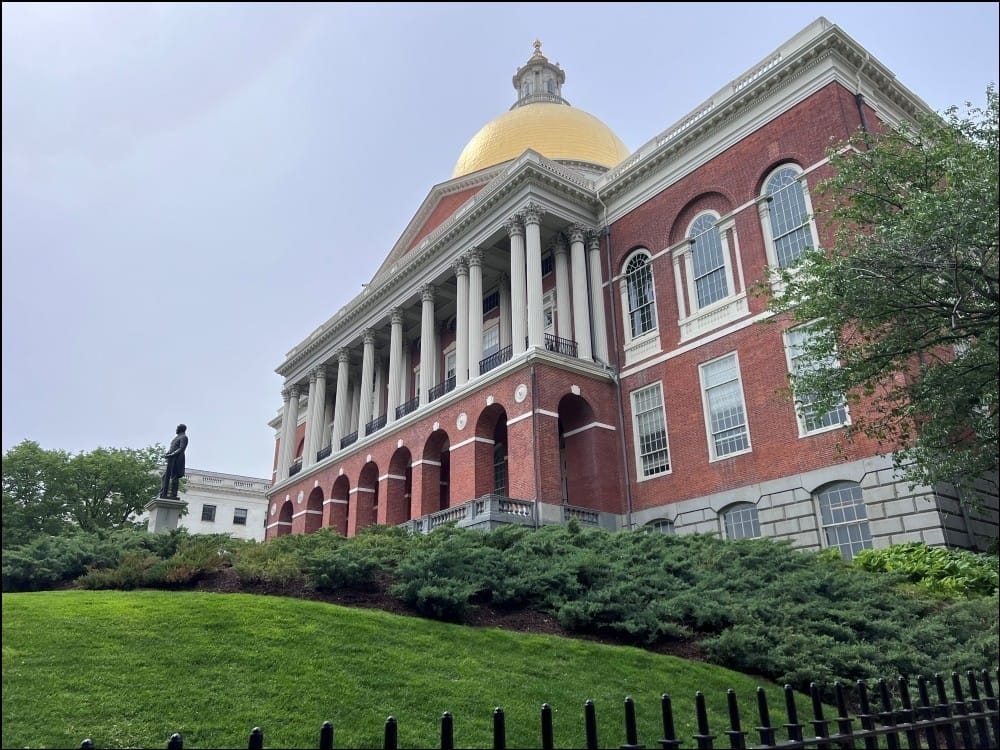
The A.I. industry just made itself hard to miss on Beacon Hill.
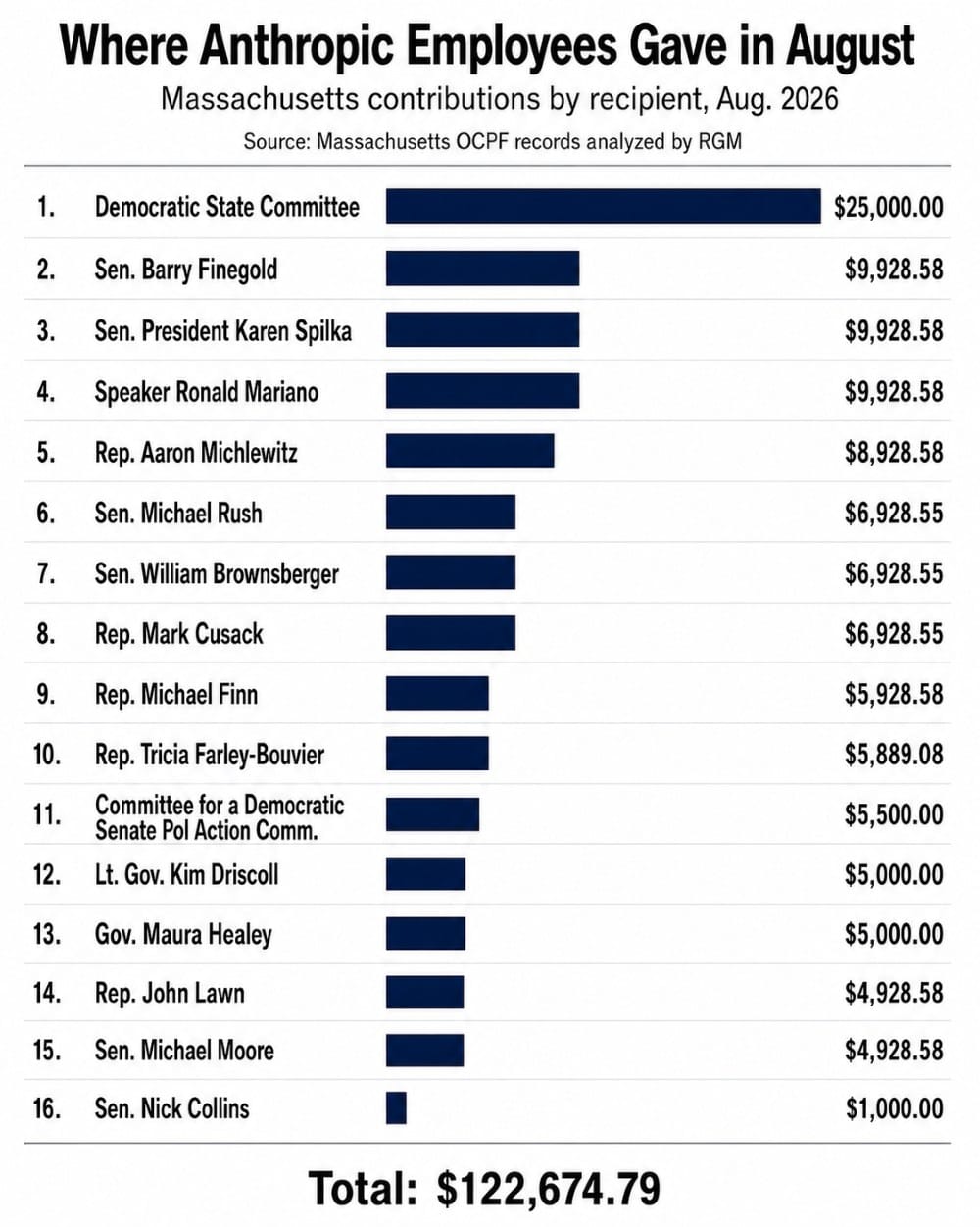
Twelve employees of Anthropic, the artificial-intelligence company behind Claude A.I., contributed $122,674.79 over just a few weeks in August to Massachusetts campaign committees and Democratic Party political accounts, according to filings with the state’s Office of Campaign and Political Finance.
About two-thirds went directly to lawmakers, heavily concentrated among legislative leaders and others with influence over a major A.I.-regulation fight underway at the State House.
The campaigns of House Speaker Ron Mariano, Senate President Karen Spilka, and Senator Barry Finegold each received nearly $10,000 from the Anthropic employees.
House Ways and Means Chairman Aaron Michlewitz—who raises vastly more campaign money than other representatives despite running unopposed since he was first elected in 2009—received $8,929. Governor Maura Healey and Lieutenant Governor Kim Driscoll, who are up for re-election this year, both received $5,000.
Finegold and Michlewitz are particularly significant: they are leading the six-member conference committee that is reconciling House and Senate versions of a broad economic-development bill.
And that’s where the timing gets interesting.
An earlier House committee version of the bill contained substantial A.I.-safety regulations. But Michlewitz’s committee stripped those provisions from the bill before it reached the floor. Rep. Mark Cusack tried to restore similar regulations, but his amendment did not make it into the final House-passed bill.
The Senate then adopted a framework strengthened by an amendment from Sen. Michael Rush, who faces Persis Yu in a Democratic primary next week and also received nearly $7,000 this month from Anthropic employees.
The bills went to conference just as the Legislature’s formal sessions ended on July 31. Conference committees hold an initial public meeting, but substantive negotiations generally happen outside public view—a longstanding complaint of transparency advocates who argue the process gives outsized power to leadership, lobbyists, and industry insiders.
Then came the August contributions, which appear unusually organized. Nine of the twelve donors fell into three exact-total groups: three gave $18,500 each, three gave $7,571.43 each, and three gave $4,500 each. Their individual contributions also followed substantially overlapping patterns, including repeated $642.85 and $642.86 donations to many of the same lawmakers.
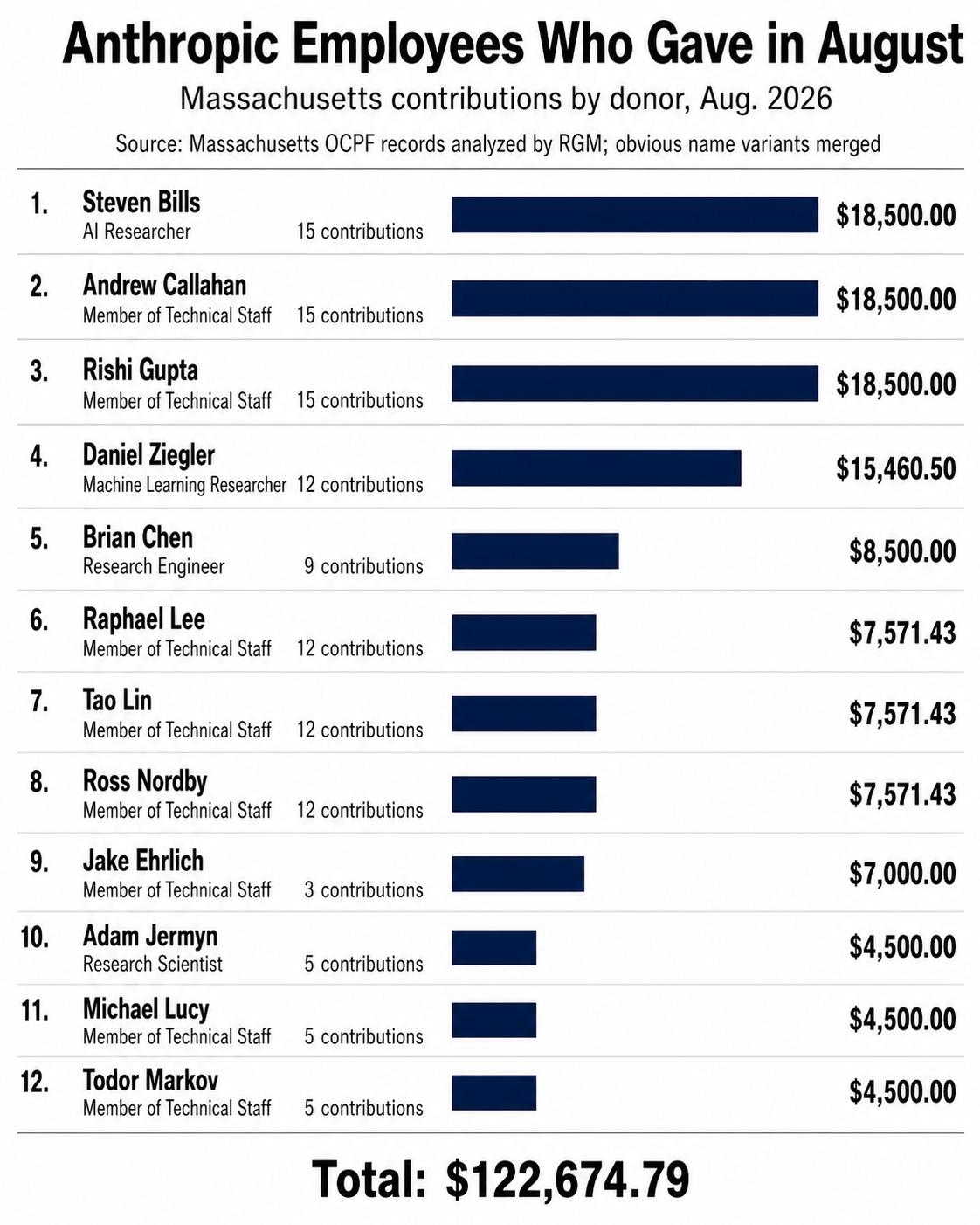
Those fractional amounts look pretty much like what you’d get by dividing a predetermined total among a prescribed list of recipients. OCPF records don’t show whether that happened, of course, or reveal who might have assembled such a list. The money came from individual employees, not Anthropic itself.
Now, Anthropic did hire Tremont Strategies, a major Beacon Hill lobbying firm, earlier this year. And lobbyists routinely advise clients about which lawmakers matter, cultivate access to them through meetings and by attending Beacon Hill fundraisers, and may recommend where campaign contributions to key legislators could open doors. Massachusetts lobbyists themselves are limited to $200 per candidate each year, but other individuals can donate $1,000.
(Earlier today, an Anthropic spokesperson told the Boston Globe, “Employees’ donations are personal and not company-directed.” That still leaves open whether Anthropic’s lobbyists—or anyone else—suggested recipients, amounts, or timing.)
But this is not the usual story of a technology company trying to weaken regulation. In fact, Anthropic says it wants stronger Massachusetts rules. Which at first blush is not surprising, given how the company has made A.I. safety its brand since it was launched five years ago by former OpenAI employees who had disagreements with the company over A.I. safety and its direction.
The Senate proposal, endorsed by Anthropic this summer, would require the largest “frontier” A.I. developers—including Anthropic, OpenAI, Google, and Meta—to maintain safety frameworks, assess catastrophic risks, report serious incidents, and undergo independent model evaluations.
OpenAI says it also supports safeguards but has lobbied for establishing universal federal standards rather than state-by-state requirements. The dispute is less about whether advanced A.I. poses risks than how aggressively individual states should regulate them now.
Based on their public statements, many of the Anthropic-employee donors appear to share serious concerns about A.I. risks. Nine of the twelve employees signed a July open letter, Pacing the Frontier, warning that A.I. may soon be able to automate A.I. research itself—known as “recursive self-improvement”—potentially accelerating the technology faster than industry, government, and society can safely manage. It calls for processes to slow frontier development to mitigate those risks.
That safety concern, of course, doesn’t erase the business interest. Anthropic has already invested heavily in safety testing and compliance systems that resemble what tougher rules would require. And regulations its employees believe are necessary may also leave the company better positioned than its competitors.
Meanwhile, Anthropic itself isn’t slowing down. Earlier this year it weakened a voluntary commitment that could have required it to pause development of increasingly powerful A.I. models, arguing that unilateral restraint doesn’t make a difference if its competitors don’t do the same. The answer, the company argues, is government-imposed common rules.
The only Berkshire County recipient of Anthropic-linked contributions was Rep. Tricia Farley-Bouvier of Pittsfield, co-chair of the legislative committee that handles technology issues including A.I. and cybersecurity. Seven Anthropic employees gave her campaign a total of $5,889.08 this week; they represent the seven largest individual contributions she has received this cycle.
Farley-Bouvier has advanced her own A.I. legislation, the FAIR Act, which she has described as a worker-protection bill. It would regulate electronic workplace monitoring and automated employment decisions, including protections against discriminatory uses of A.I. The bill was passed out of her committee last December but has not advanced from House Ways and Means.
In an interview on Friday, she told me that her larger focus this year has been comprehensive data-privacy legislation that is now itself in conference committee. She described that bill as deliberately “consumer centered,” saying many industry representatives sought to weaken it or win exemptions. “I feel really comfortable with my decision-making to keep the consumer centered in this,” she said.
Farley-Bouvier said she met with Anthropic representatives earlier this year as the company was beginning to expand its state-level advocacy, and has also met with members of Tremont Strategies, its Massachusetts lobbying firm. But she said those conversations were “really close to exclusively around data privacy,” rather than the frontier-A.I. provisions now being negotiated in the economic-development bill.
On those provisions, however, she is broadly aligned with Anthropic. “I do think that frontier model regulation is necessary,” she said, adding that Anthropic has “a better view of how A.I. should be regulated than I have seen the other companies have.” She also said she prefers strong federal regulation of frontier A.I. models but remains skeptical that Congress will be able to enact it.
She told me that she was not entirely surprised when the Anthropic contributions appeared. Colleagues working on technology policy in other states had told her that Anthropic employees were beginning to support state legislators. “I had no idea the amounts that would come in,” she said.
Before the Anthropic contributions, nearly all of her campaign receipts this cycle came from lobbyists and PACs rather than local individual donors. She acknowledged that Friday, saying her committee chairmanship and increased seniority had created more fundraising opportunities on Beacon Hill.
Farley-Bouvier said she didn’t hold a local fundraiser this cycle because she is running unopposed and is mindful that “people are pretty stretched these days.”
In January this year, she told me that people shouldn’t assume that campaign contributions—including from lobbyists representing technology companies—dictate policy. The better test, she said, is “what’s in the bill.”
As always, Mark Felt’s advice to Woodward and Bernstein—“follow the money”—is worth heeding if you plan to track what happens over the coming weeks and months on A.I. regulation. Anthropic has clearly decided that state legislatures matter. As does OpenAI: it hired its own Massachusetts lobbyist last month.
To date, though, I haven’t found anything resembling the same wave of employee contributions. I suppose this could be a job for an A.I. agent programmed to keep checking the OCPF database for new contributions...
As for A.I. itself, I haven’t really waded into the much larger questions yet, but I expect to spend more time on them in future editions of Field Notes & Evidence.


