

In October of 2024, at a public meeting in Lee, Massachusetts, Jessica Burkhamer, a scientist with the state’s Department of Public Health, was asked a familiar question—familiar, that is, to anyone who has followed D.P.H.’s decades-long relationship with Berkshire County communities affected by contamination by polychlorinated biphenyls, or PCBs, from General Electric. How much exposure to PCBs had local residents experienced? More specifically, was there any difference between levels found in the blood of Berkshire County residents and those of people living in Boston?
She said she couldn’t answer the question “directly” because “it’s very unusual to do PCB monitoring in blood.” There was national data, she said, but nothing granular enough to compare communities.
She pointed instead to a small study conducted twenty years ago at Pittsfield’s Allendale School, a remediated site adjacent to a PCB landfill, which she said showed blood levels at or below the national average.
The answer might have passed as the kind of cautious explanation typical of public-health communication. But it appears to have been something else.
According to documents obtained through public-records requests, D.P.H. had prepared for the meeting, which was hosted by the U.S. Environmental Protection Agency and focused on airborne PCBs, by drafting an eleven-page document titled “DRAFT Talking Points EPA Public Meeting October 10, 2024,” where staff anticipated questions about PCB blood testing and outlined how to respond.
D.P.H. scientists Julie Cosio, at left, and Jessica Burkhamer, field questions on PCB blood levels at a public forum in Lee, Massachusetts on October 10, 2024. (U.S. EPA)
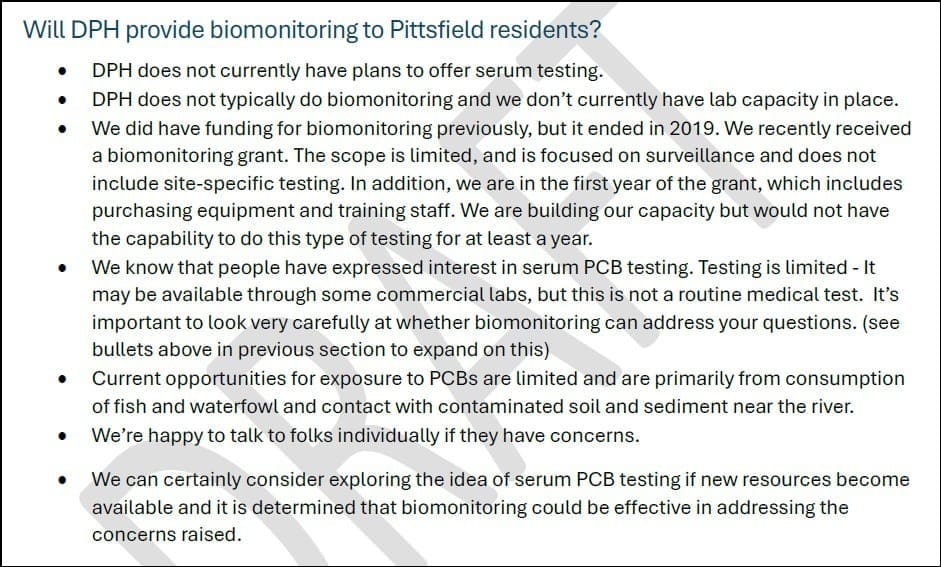
In a section titled “If asked,” the guidance was explicit. Responses should say the agency “does not typically do biomonitoring,” “does not currently have plans to offer [blood] testing,” and lacks the capacity to provide it.
D.P.H. initially withheld the talking-points document under a public-records exemption for policy development—an exemption designed for internal deliberations, not for scripted answers to anticipated questions at a public meeting. It was later released.
Burkhamer’s answer tracked the script. But the script was wrong: the state has long done precisely what it told that Berkshire County audience it does not do.
From 2014 to 2019, D.P.H. operated a federally funded biomonitoring program that conducted blood and urine testing for PCBs and other contaminants across Massachusetts. One of its stated goals was to establish a statewide baseline of PCB exposure—the kind of data that could help answer the question asked in Lee.
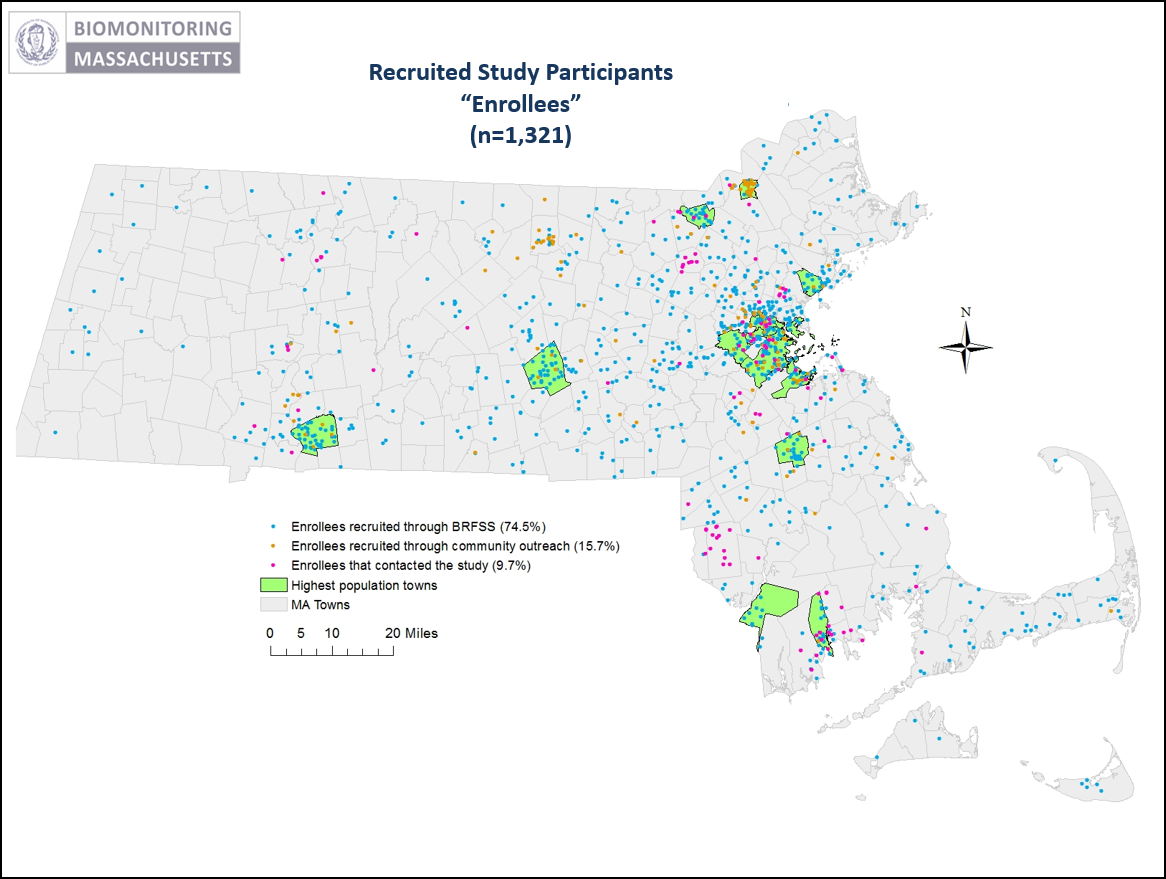
According to a 2018 D.P.H. map showing the location of enrolled participants to date, few appear to be from the Berkshires. The program ultimately took samples from 589 participants in 161 communities, according to grant documents.
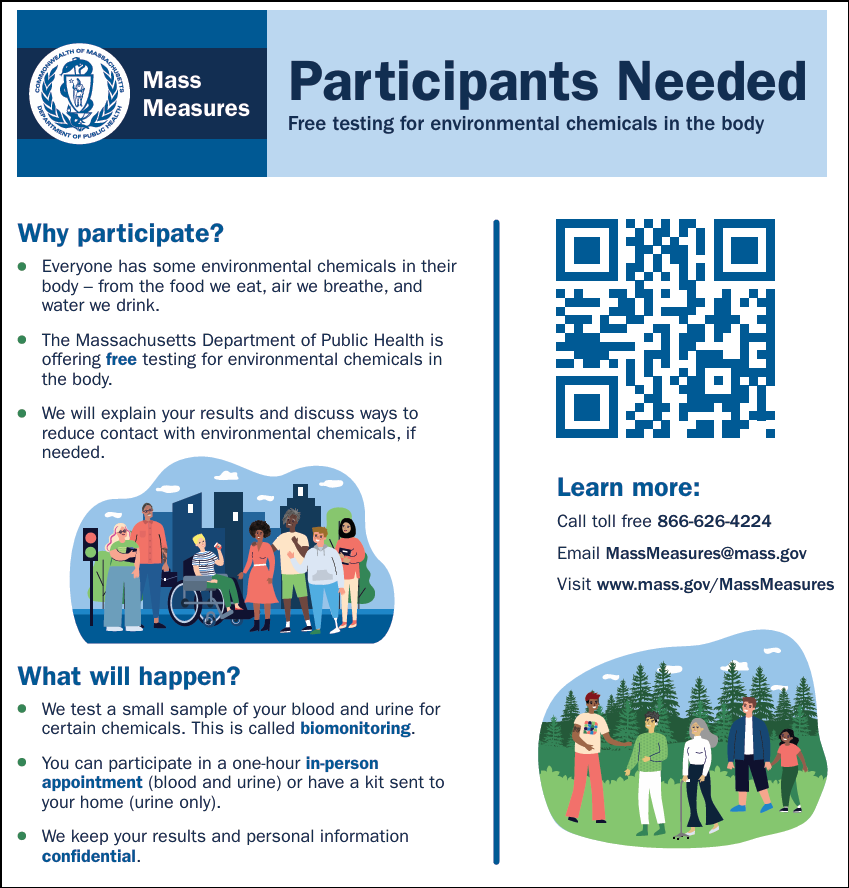
A second biomonitoring program, known as Mass Measures and also funded by the federal Centers for Disease Control and Prevention, launched just weeks before the Lee meeting and will continue through 2027. Its focus is on eleven “environmental justice communities“—none located in Berkshire County—as well as enrolling participants statewide.
In its own materials, D.P.H. describes biomonitoring that includes PCB testing not as unusual but as “a powerful tool” for understanding environmental exposure and guiding public-health responses.
The contradiction runs deeper still. A conference poster co-authored by D.P.H. scientist Julie Cosio—prepared for a national public health laboratory conference in 2017—describes the earlier program’s methods and goals, including establishing that statewide PCB-level baseline. Results from biomonitoring “are extremely valuable in environmental health surveillance when seeking to understanding [sic] the nature and extent of environmental chemical exposure,” the poster concluded.
Cosio’s name also appears as the author of a confidential summary of a key inter-agency meeting where talking points were reviewed, described below. So the same scientist who helped build and publicly present a statewide PCB biomonitoring program was among those developing talking points explaining that D.P.H. doesn’t do this kind of thing.
The Lee meeting on October 10, 2024 was not an isolated instance. Nineteen days later, representatives from agencies including D.P.H., E.P.A., MassDEP, C.D.C., as well as Pittsfield Mayor Peter Marchetti and other city officials, gathered privately to prepare for an upcoming presentation before the Pittsfield City Council’s Public Health and Safety Committee.
A confidential summary of that session, written by Cosio, shows D.P.H. planned essentially the same message and talking points for the second venue, downplaying the utility of the blood testing it was ramping up to do in targeted communities and statewide. The memo also noted, “We are not recommending that physicians seek out serum testing for their patients.”
Even as the memo notes that residents had been asking city officials about testing, it details the same D.P.H. talking points: the agency had “no plans to offer serum testing” and that it was “not something we routinely do or have the capacity to do.” The meeting notes also observe, in passing, that “local press doesn’t seem to be picking up the story.”
When Burkhamer and Cosio appeared before the City Council committee on November 7, 2024, there was no mention of plans for several years of free PCB testing. (Burkhamer and Cosio did not respond to requests for comment.)
When I asked D.P.H. about the contradictions between its public statements, the memos, and its own biomonitoring programs, it did not answer directly. Instead, a spokesperson emphasized that most people have some level of PCBs in their blood, that results are difficult to interpret, and that program scope is determined by federal funding guidelines.
Evaluating all of this is difficult because the full record, including aggregate results from the 2014-2019 program, remains out of reach. In response to an extensive public-records request filed last August—seeking records about how its biomonitoring programs were administered, results from the earlier study, but not any identifiable health information about individual participants—D.P.H. has produced only a small number of documents, primarily grant applications and formal C.D.C. reports. The department says it is withholding at least 2,360 more.
Internal emails and memoranda that would clarify how decisions were made about communicating with residents in the Berkshires and elsewhere have not been released. And despite telling C.D.C. in a 2021 grant-closeout report that it would publish findings from the earlier program, which ended in 2019, in a peer-reviewed journal, D.P.H. has yet to release the results. (The D.P.H. spokesperson said its data analysis is not yet complete; C.D.C. referred questions back to D.P.H.)
To withhold documents, D.P.H. has cited a statute meant to protect participant data, arguing it applies broadly to records about the programs themselves. In December, the state’s Supervisor of Records ordered the department to justify each withholding with required details. More than four months later, it has not done so, and the matter remains the subject of an ongoing appeal.
Meanwhile, officials in Lee told me they learned only recently that free PCB blood testing was available through Mass Measures—not via outreach from D.P.H., but from a resident who saw a flyer at a medical office.
The timing of all of this matters. The 2014–2019 biomonitoring program ran concurrently with years of contentious legal action and negotiations over the Rest of River cleanup, including the 2020 agreement to build a PCB landfill in Lee that residents have fought ever since. A 2021 internal D.P.H. memo summarizing public comments on the cleanup noted resident requests for “baseline blood testing pre and post River clean-up”—data that could have provided independent evidence of exposure levels before remediation began, and a benchmark to measure whether the cleanup was effective. Those requests, the record suggests, went unanswered.
To be fair, blood testing for PCBs has real limitations: it cannot easily establish when exposure occurred, from what source, or whether illness will follow. Different types of PCBs degrade at different rates in the body. Public health officials must navigate these and other complexities and craft effective communication strategies, all at a moment when public health is under attack and “doing your own research” is a popular mantra.
But prepared language, coordinated across agencies and delivered in public meetings in Lee and Pittsfield, telling communities most affected by one of New England’s largest Superfund sites that the state does not typically do biomonitoring—while it was, in fact, doing it—is something else. It reflects a choice the department has not fully explained. That the local press had not picked up the story, as D.P.H. noted, may have made that choice easier.


