

PCE in indoor air: A July report to MassDEP said PCE (“perc”) had been detected above a state commercial threshold at 14 and 20 Railroad Street, prompting installation of air purifiers and more testing.
Tests began last winter: At The Barrington House (284 Main Street), environmental consultants found PCE and TCE, another chlorinated solvent, in groundwater and vapor beneath the building above state reporting or screening levels, but not in basement air.
Decades of dry cleaning: Leonard’s Cleaners and Kaplan’s Cleaners operated from 1939 to 1981 in or near the same Railroad Street buildings now under investigation. PCE has long been a popular dry-cleaning solvent.
Health concerns: Long-term exposure to PCE and TCE can affect the liver, kidneys, and nervous system, and both chemicals have been linked to increased cancer risk.
Source still unknown: MassDEP said the findings so far are preliminary. The source and full extent of the contamination remain unknown.
Environmental investigators have expanded testing in downtown Great Barrington after a chemical long used by dry cleaners was detected this summer in indoor air at two Railroad Street properties, prompting installation of air-purification equipment while its source and extent are investigated.
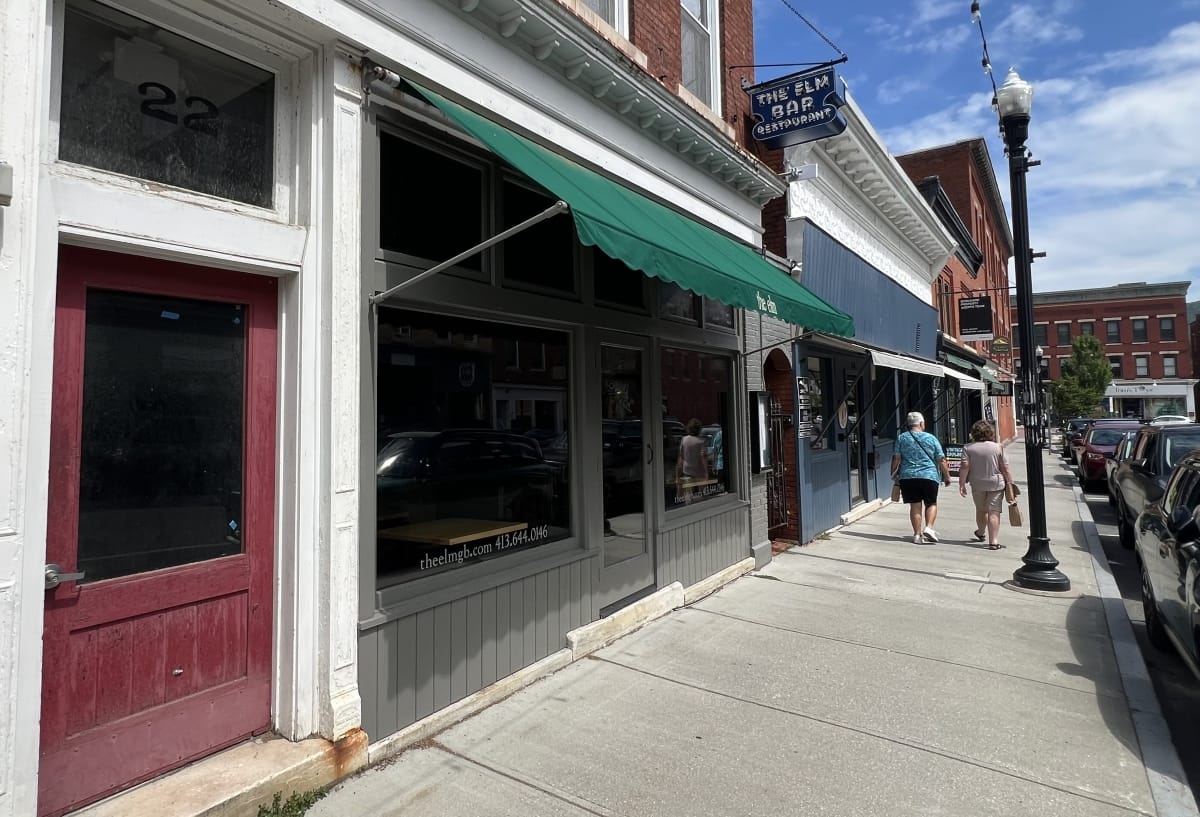
At 20 Railroad Street, home to the restaurants The Elm and Uva Pizza, perchloroethylene—commonly known as PCE or “perc,” and also called tetrachloroethene—was detected at more than fifteen times the state commercial indoor-air threshold in the basement and more than twice the threshold on the first floor.
At neighboring 14 Railroad, home to Robert Lloyd Vintage Barware, PCE was detected at slightly above the state threshold.
The test results, which were submitted last month to state regulators by an environmental consultant, said the levels did not constitute an “imminent hazard” and that additional testing was underway.
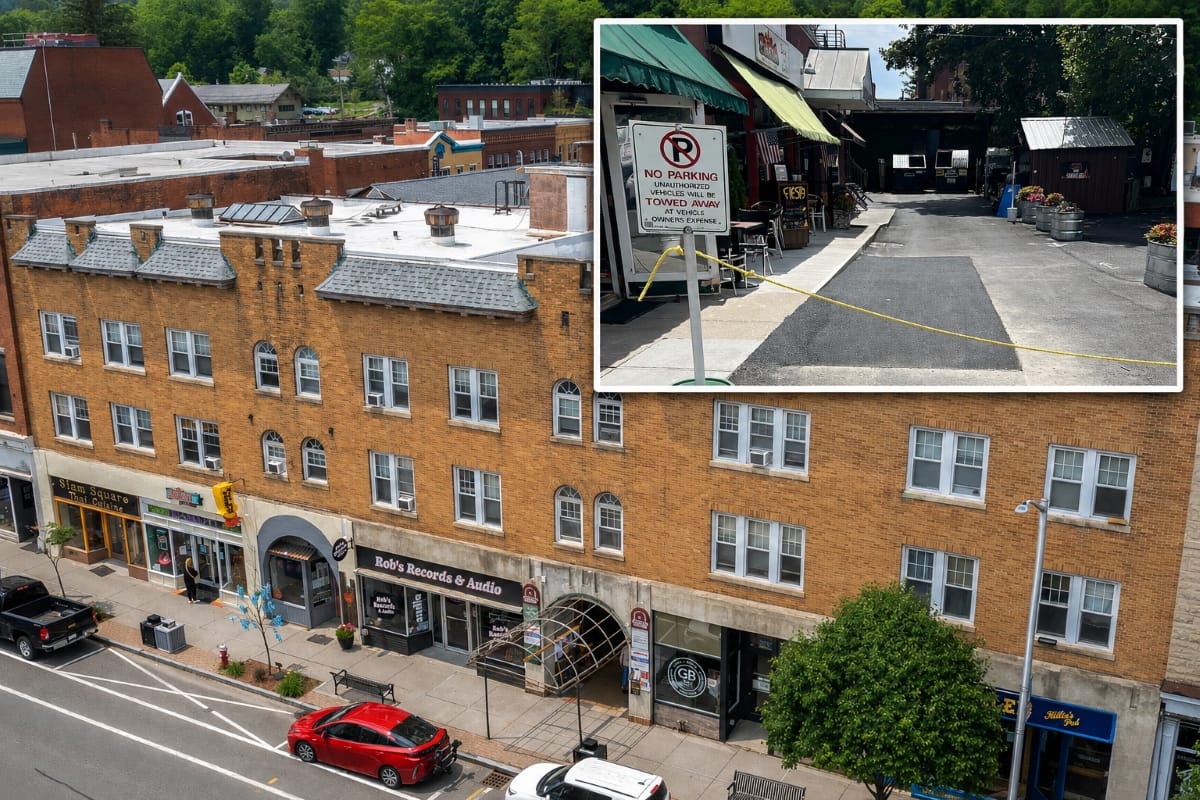
The ongoing investigation grew out of an environmental assessment that began last winter at The Barrington House, a mixed-use building at 284 Main Street with restaurants, retail businesses, and twenty-seven apartments. The property, which is owned by real-estate developer Richard Stanley, has been publicly listed for sale since last summer.
Testing in and around the rear portion of that property found PCE and trichloroethene, or TCE, in groundwater and vapor beneath the building at levels above state reporting or screening standards. An indoor-air sample from a basement area inside The Barrington House did not contain detectable PCE or TCE.
All of this is unfolding along a stretch of Railroad Street where dry-cleaning businesses moved, merged, and changed hands over more than four decades.
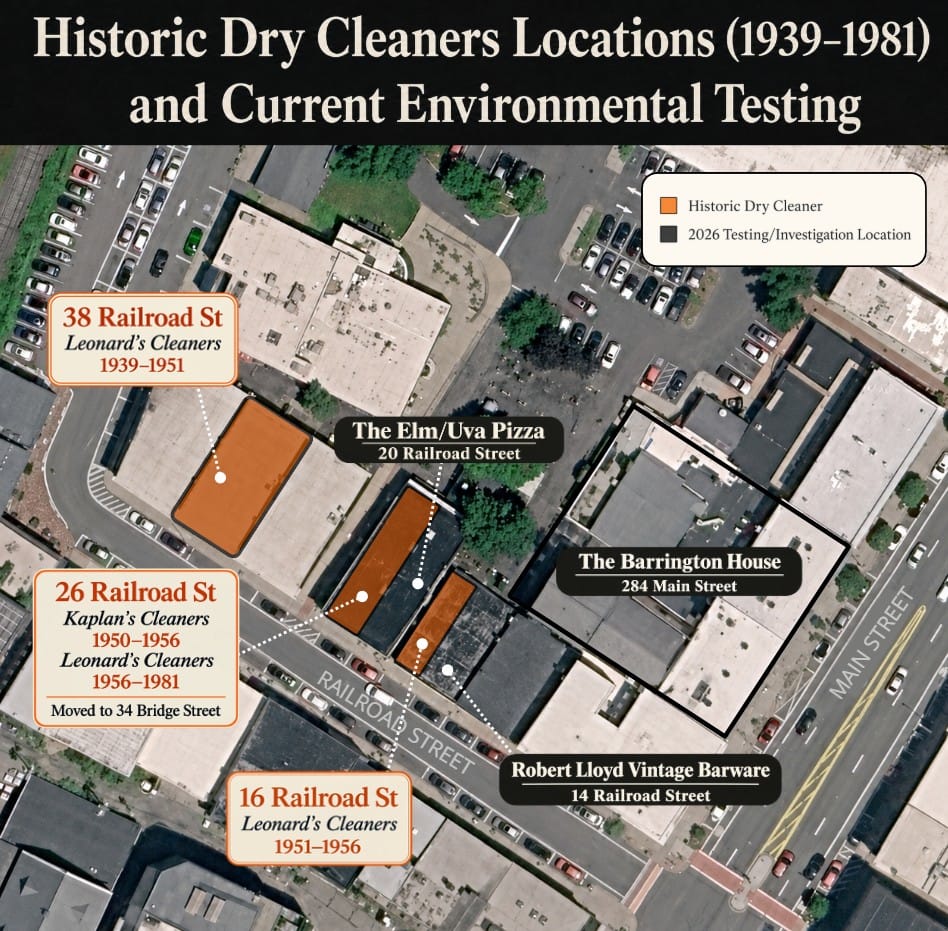
Leonard’s Cleaners opened at 38 Railroad Street in 1939 and later relocated to 16 Railroad. Kaplan’s Cleaners began operating at 26 Railroad in 1950 and was acquired by Leonard’s in 1956. The combined business remained at 26 Railroad until 1981.
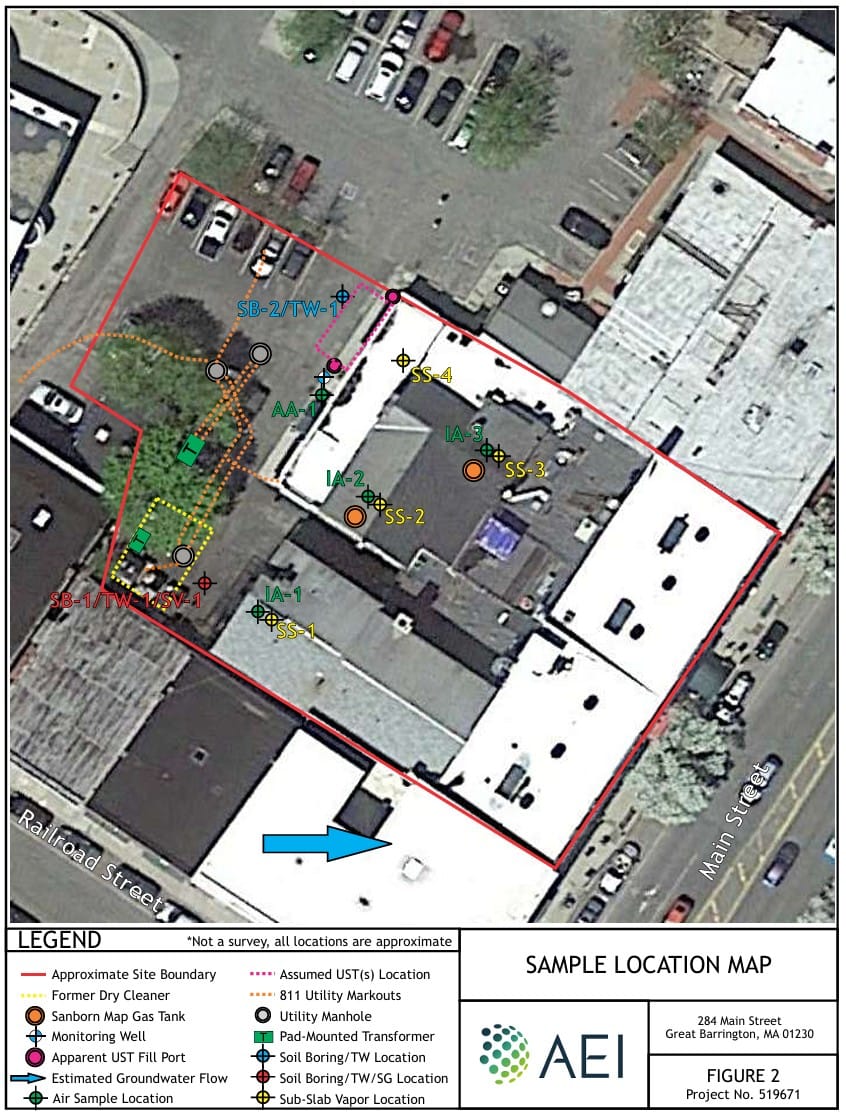
A 1947 fire-insurance map located by an environmental consultant also depicts a dry cleaner in what is now a parking area behind The Barrington House.
In a March report later provided to the Massachusetts Department of Environmental Protection, the company, AEI Consultants, which had prepared the assessment for a company called Lone Park Realty, listed that former dry-cleaning use as a “recognized environmental condition” and proceeded to sample groundwater and underground vapor.
To date, investigators have not identified the source of the contamination, determined how far any underground plume may extend, or established that it came from a former dry-cleaning business.
In response to e-mailed questions earlier this month, a MassDEP spokesperson described the work so far as a “preliminary assessment” and said the agency “anticipates additional submittals.”
PCE was for decades the dominant solvent used by the dry-cleaning industry because it removes grease and stains and, unlike the petroleum-based solvents that preceded it, is nonflammable. But before modern hazardous-waste regulations were adopted, spent solvent, used filters, and spills and waste from handling and storage could lead to releases into the environment.
PCE and TCE are also used in other products and industrial applications, including degreasers and automotive brake cleaners.
Both are volatile chlorinated chemicals that can persist underground, move through soil and groundwater, and enter buildings as vapor through cracks in foundations and along utility connections. TCE can also form as PCE breaks down in the environment.
Long-term exposure to PCE and TCE can affect the liver, kidneys, and central nervous system, according to the federal Agency for Toxic Substances and Disease Registry. Both chemicals have been linked to increased cancer risk, and exposure to TCE poses particular concerns during the first trimester of fetal development. The potential health impacts depend on the concentration, duration, and route of exposure.
What the Barrington House Testing Found
The March report found the highest sub-slab-vapor concentration in a sample collected beneath part of The Barrington House near the dry-cleaner area shown on the 1947 insurance map. PCE was measured at 313 micrograms per cubic meter, just above the state commercial screening value and more than three times the residential screening value.
TCE was measured at 68.3 micrograms per cubic meter, more than twice the residential screening value but below the limit for commercial and industrial settings.
A groundwater sample from The Barrington House property contained PCE at 10 micrograms per liter and TCE at 7.9 micrograms per liter, both exceeding applicable state reportable concentrations.
MassDEP uses screening values to determine whether additional investigation or response measures may be needed. Residential screening values are typically lower than commercial limits because people generally spend more time at home than in commercial buildings.
In early May, after receiving these test results, MassDEP issued a formal notice of responsibility and directed Stanley, who owns The Barrington House through his Egremont-based company, Reistan Enterprises, to take steps to identify and address contamination.
(Stanley did not respond to multiple interview requests.)
Under state regulation known as the Massachusetts Contingency Plan, property owners and others deemed responsible or potentially responsible for contamination can be required to investigate and remediate it, even if the release was caused by a former business or previous owner. They typically hire private environmental consultants known as licensed site professionals to conduct testing and prepare reports and response plans under the oversight of MassDEP’s Bureau of Waste Site Cleanup.
If an investigation determines that contamination migrated onto a property from elsewhere, state regulations also allow an owner to seek “downgradient property status,” which can limit the owner’s cleanup obligations.
MassDEP can also issue enforcement orders and levy fines when required work is not carried out. Last month, the agency fined the owner of a former dry-cleaning property in Northbridge $33,000 for failing to respond to suspected solvent contamination in groundwater and low levels of dry-cleaning chemicals detected in indoor air at nearby homes.
The Investigation Moves to Railroad Street
In late May, Coneco Engineers & Scientists, an environmental consultant hired by Reistan Enterprises, told MassDEP that it planned to evaluate the PCE and TCE release discovered in the earlier AEI report and collect additional samples from the nearby properties at 14 and 20 Railroad Street.
According to a July 17 update provided to MassDEP, PCE measured 4.58 micrograms per cubic meter in the basement air of 14 Railroad and 4.30 on the first floor, compared with a state commercial indoor-air threshold of 4.1.
At 20 Railroad, where the restaurants are located, the concentrations were 62.8 micrograms per cubic meter in basement air and 8.80 on the first floor.
The July 17 MassDEP update reported only PCE concentrations and did not say whether TCE was detected at either building. Asked about any TCE sampling, the MassDEP spokesperson said, “No additional information regarding sampling or lab reports have been provided at this time.”
Coneco told MassDEP that the July results did not establish an “imminent hazard,” a Massachusetts regulatory designation that requires a more urgent response. In addition to deploying air purifiers, the company said it would perform additional testing that includes drilling and more indoor-air sampling.
Jeff Neil, a co-owner of The Elm and Uva Pizza, said the restaurants operate at 20 Railroad Street, which his company leases. His landlord had told him environmental testing was planned, he said, but not what it was for. Neil said he did not learn the results until contacted by a reporter.
“We are acting on it today,” Neil wrote in an e-mail on Friday. “We are informing our staff on what we know and are limiting basement use as a precaution until we learn more.”
Joshua Cohen of The Cohen Group LLC, which real-estate records list as the owner of 20 Railroad Street, did not respond to e-mails and phone messages.
Carrie Chen, an owner of the building that includes 14 Railroad Street, said she was traveling and unavailable to comment. Robert Lloyd said he knew an air purifier had been installed in his store and referred other questions to Chen.
A Long History of Dry Cleaners on Railroad Street
The current investigation has drawn attention to the history of dry cleaners on Railroad Street, which can be traced through decades of newspaper stories and advertisements.
Leonard’s Cleaners, established and run by two generations of the Kosberg family, began operating a dry-cleaning business in 1939 at 38 Railroad Street—the building containing retail shops and upstairs offices that, in recent years, also housed the Baba Louie’s pizza restaurant until it closed in 2025.
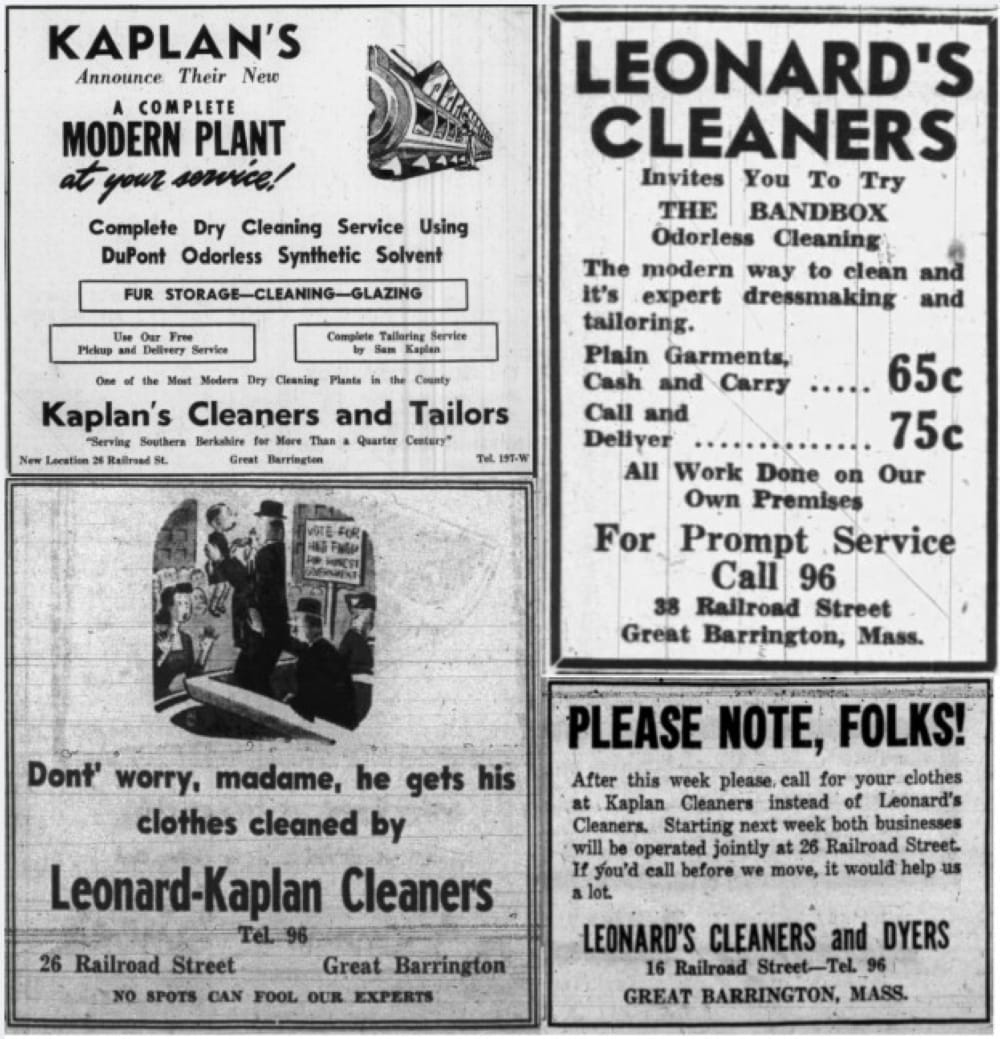
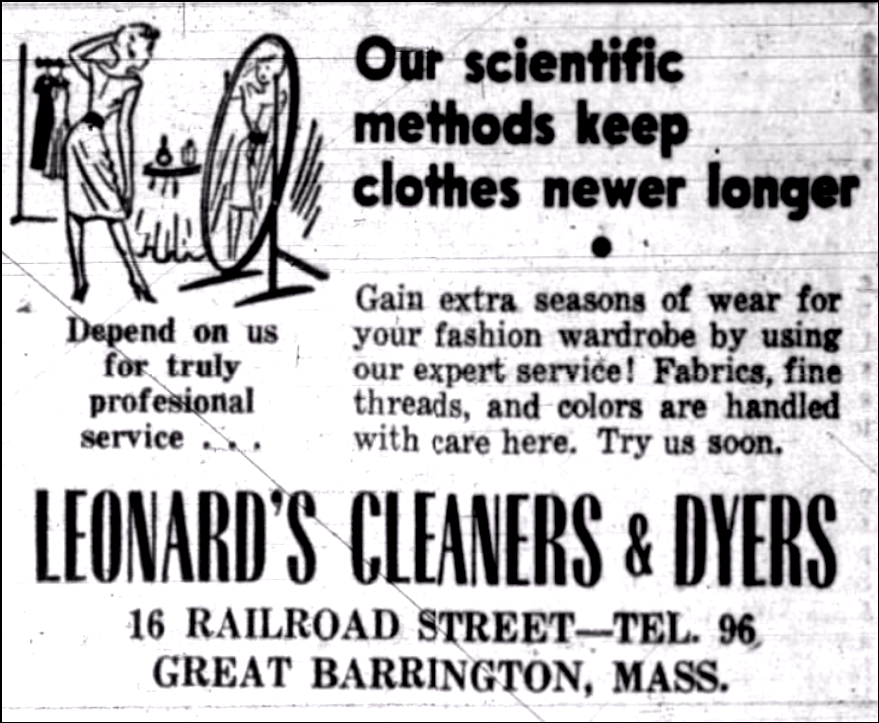
In 1951, Leonard’s relocated to 16 Railroad Street, the western half of the building at 14-16 Railroad Street.
Kaplan’s Cleaners opened in the early 1920s as a storefront and tailoring business at 8 Railroad Street. In the 1930s, it added a dry-cleaning plant that was built inside a former trolley-power station off Route 7 in Sheffield.
In 1950, Kaplan’s relocated its dry-cleaning plant and storefront to 26 Railroad Street, the western half of the building that today includes The Elm and Uva Pizza.
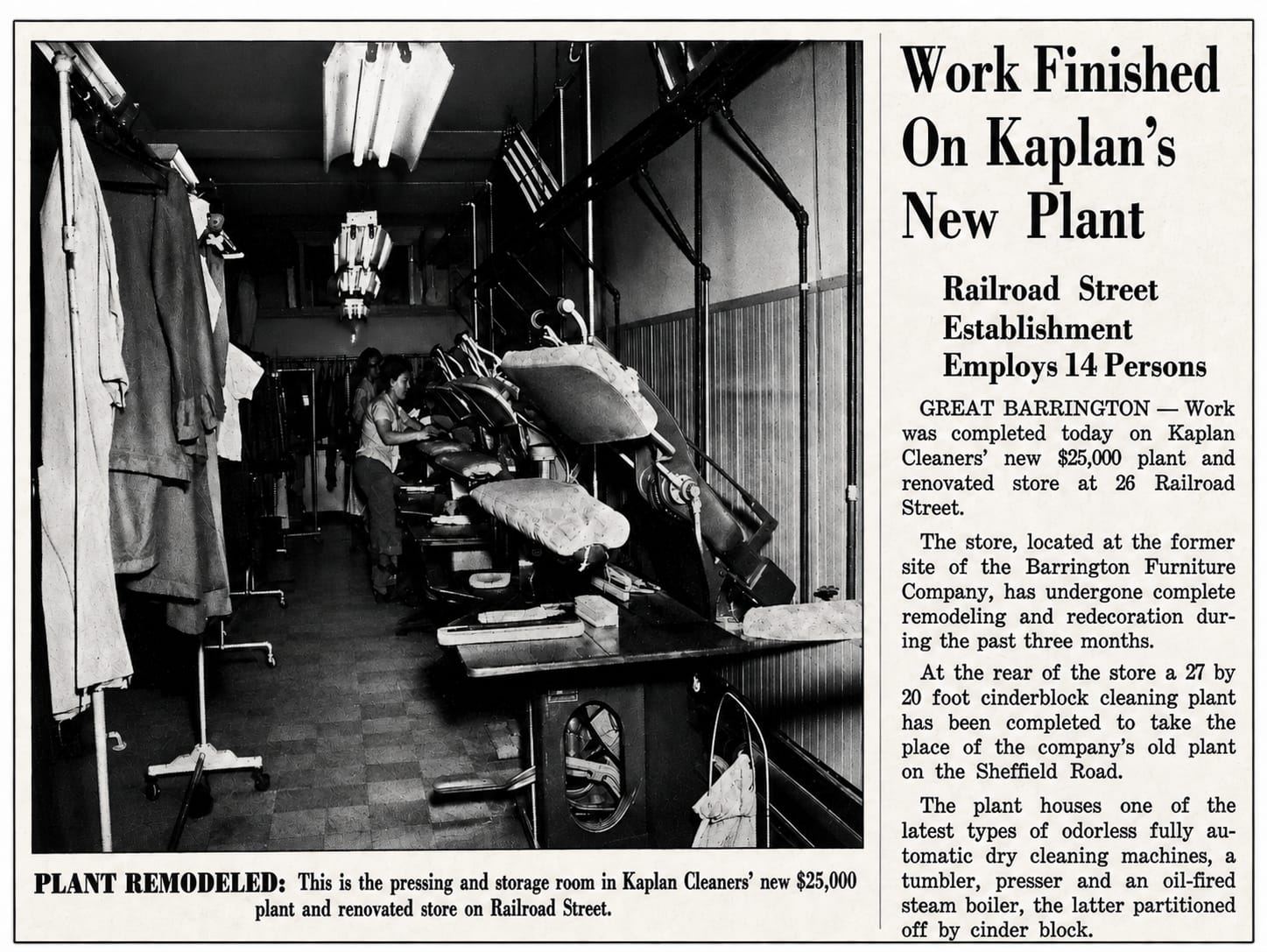
Leonard Kosberg acquired Kaplan’s in 1956, and the combined business operated at 26 Railroad until 1981, when it moved to 34 Bridge Street.
A Familiar Problem in Great Barrington
Nothing in the available Railroad Street or Barrington House testing data so far approaches the scale of contamination at a longstanding Great Barrington brownfield site: the former Ried Cleaners property at 218 Main Street.
Environmental investigations at Ried began in 2008, two years after the business closed, and found substantial contamination in soil and groundwater associated with dry-cleaning operations that began there in the early 1950s.
At various stages, groundwater samples contained PCE in the tens or hundreds of thousands of micrograms per liter—orders of magnitude higher than the concentrations detected last winter in groundwater samples at The Barrington House.
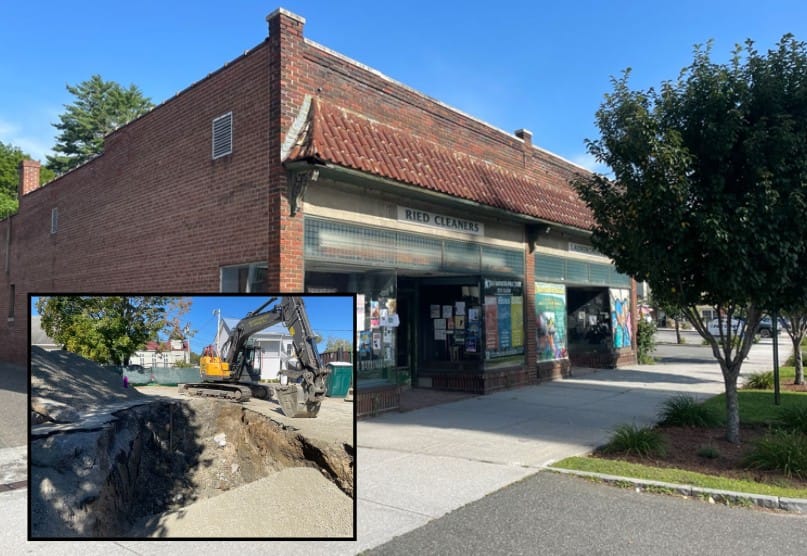
At the Ried site, investigators attributed the contamination in part to leaking underground tanks that held PCE-based solvents and to releases of chemicals through floor drains.
It spread beyond the former cleaners’ property to affect the neighboring U.S. Post Office, where today air purifiers run in the lobby and staff work areas. According to regulatory filings, employee access to basement areas of the post office is restricted because of chemical-vapor concerns.
Twenty years after Ried Cleaners closed, monitoring, evaluation, and cleanup work continues, much of it funded through federal brownfield grants. Last year, nearly 1,500 tons of contaminated soil were excavated from the property, which is now owned by the Town of Great Barrington.
There have been other sites in Great Barrington. In 2016, contamination from dry-cleaning solvents was discovered and remediated at Leonard’s Cleaners’ final location, 34 Bridge Street, where Laramee’s Cleaners later operated. The cleanup occurred during redevelopment of the property into Powerhouse Square, a mixed-use building that includes the Berkshire Co-Op Market.
A National Issue
Legacy contamination from dry-cleaning solvents continues to be discovered around the country, sometimes decades after the businesses that used them closed.
A 2004 E.P.A. report estimated that soil or groundwater contamination was associated with about three-quarters of the thirty thousand commercial dry-cleaning facilities then operating nationally, and that a significant number of contaminated sites might remain unidentified.
States have taken different approaches to both preventing future contamination and dealing with the legacy of older dry-cleaning operations.
California phased out PCE use in dry cleaning and prohibited it entirely beginning in 2023, while here in New England, Connecticut created a dedicated remediation program funded in part by a one-percent surcharge on dry-cleaning receipts. That revenue can be used to assess and clean up eligible current and former dry-cleaning properties and to support state investigations of contamination. Connecticut is one of more than a dozen states that had, or currently have, similar programs.
Massachusetts has no comparable dry-cleaner-specific remediation fund and has not phased out PCE use. Instead, contamination at former dry-cleaning properties is addressed under the state’s general cleanup and brownfields programs.
Compared to the period when the Railroad Street businesses operated, Massachusetts dry cleaners that still use PCE are now subject to far more extensive regulatory requirements. They must submit annual compliance certifications to MassDEP that cover requirements for air emissions, industrial wastewater, leak inspections, solvent-use records, and hazardous-waste disposal.
In 2024, the E.P.A. determined that PCE presents an unreasonable risk to human health under certain conditions, and the solvent is being phased out for all dry-cleaning use by 2035.


