

More than six months after Gary Fretwell, a seventy-year-old resident of Great Barrington’s Brookside Manor senior apartments, was struck and killed at the Reed Street crosswalk on South Main Street, the same aging crosswalk lights remain in place and continue to malfunction.
In January, Town Manager Liz Hartsgrove acknowledged that the crosswalk system was not functioning when Fretwell was struck by a pickup truck while walking home just after sunset. She said faulty batteries were replaced and the system “fully tested.” The fatality, she said, “underscored the importance and opportunity of being proactive,” and she promised “immediate crosswalk improvements.”
Over the past week, I made multiple trips to the Reed Street crosswalk to test the equipment and observe pedestrians and traffic. The motion sensor on the east side of South Main Street activated the flashing warning beacons, but the sensor on the west side did not—echoing the failure documented after the January crash. According to the police report, when the interim police chief, Adam Carlotto, arrived at the scene and tested the equipment, “the flashing lights that were supposed to warn drivers of someone in the crosswalk were not being activated.”
Last Saturday, I recorded people passing the nonfunctioning west-side sensor and entering the crosswalk while cars and trucks continued past. Since late winter, I’ve also observed the beacons flashing when no pedestrians were nearby, in different weather and at different times of day. Michael Knodler, a traffic-safety engineer and director of the UMass Transportation Center, told me earlier this year that such false activations can diminish a warning system’s effectiveness by teaching drivers that flashing lights do not necessarily mean someone is crossing.
Video recorded in late July shows pedestrians entering the Reed Street crosswalk from the west side without the warning lights activating. (Video by Bill Shein/RGM)
The dangers at the Reed Street crossing long predate Fretwell’s death. One Brookside resident warned town officials about intermittent failures as early as last October, three months before the fatal crash, and continued reporting faulty equipment this spring, according to e-mails I reviewed. In May, a public-works employee tested the crosswalk equipment and reported that it appeared to be working during the visit, e-mails show.
Residents of the senior and income-qualified housing developments along South Main Street have also complained for years about speeding traffic and incomplete sidewalks that force some people to walk—or travel by wheelchair—along the road shoulder. That includes children living at Windrush Commons, a forty-nine-unit apartment complex on South Main Street that opened in 2023.
The existing warning system was installed in 2006 after a Brookside resident was struck and killed at the crossing. The town did not fund the equipment; residents raised private money to help pay for a reconfigured crosswalk and the motion-activated warning beacons. Another Brookside resident, traveling in a motorized wheelchair, was struck and killed in the crosswalk in 2015.
The twenty-year-old system lacks push-button activation and provides no audible confirmation to pedestrians. Many newer devices broadcast, “Lights are flashing” twice upon activation.
A modern pedestrian-activated crosswalk system like this one on Main Street in Housatonic provide audible confirmation that warning lights are flashing. (Video by Bill Shein/RGM)
As I reported in February, modern replacement equipment was already on the way. The town reached an agreement last year with the Massachusetts Department of Transportation to receive five new crosswalk-warning assemblies through a federally funded program designed to provide “quick-turnaround materials to help communities reduce fatalities while concurrently working on longer-term safety projects,” according to MassDOT spokesperson John Goggin. He said the program has awarded two hundred and nineteen systems statewide, including twelve in Berkshire County.
The assembly designated for the Reed Street crosswalk, valued at $13,250, includes push-button activation, audible voice confirmation, rectangular rapid-flashing beacons, and overhead lighting that illuminates the crosswalk at night. MassDOT supplied the equipment at no cost to the town, which is responsible for installation.
Under the agreement, municipalities must install the assemblies within ninety days of delivery and may request an extension within the first sixty days. Without an approved extension, uninstalled equipment must be returned to MassDOT.
Goggin told me that MassDOT delivered the equipment to Great Barrington on April 24. As of July 30, none of the five assemblies had been installed. Despite two days of inquiries, MassDOT did not say whether the town had requested an extension or whether one had been approved.
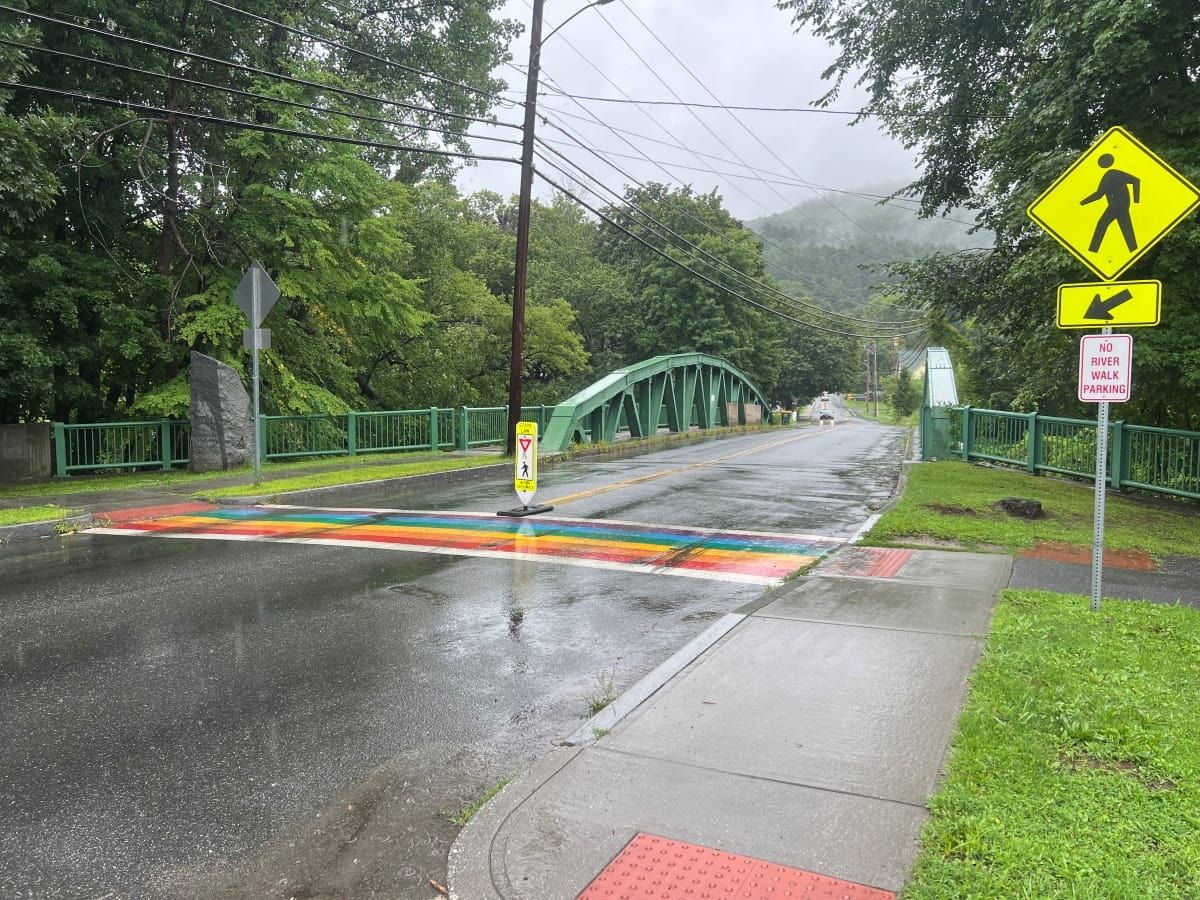
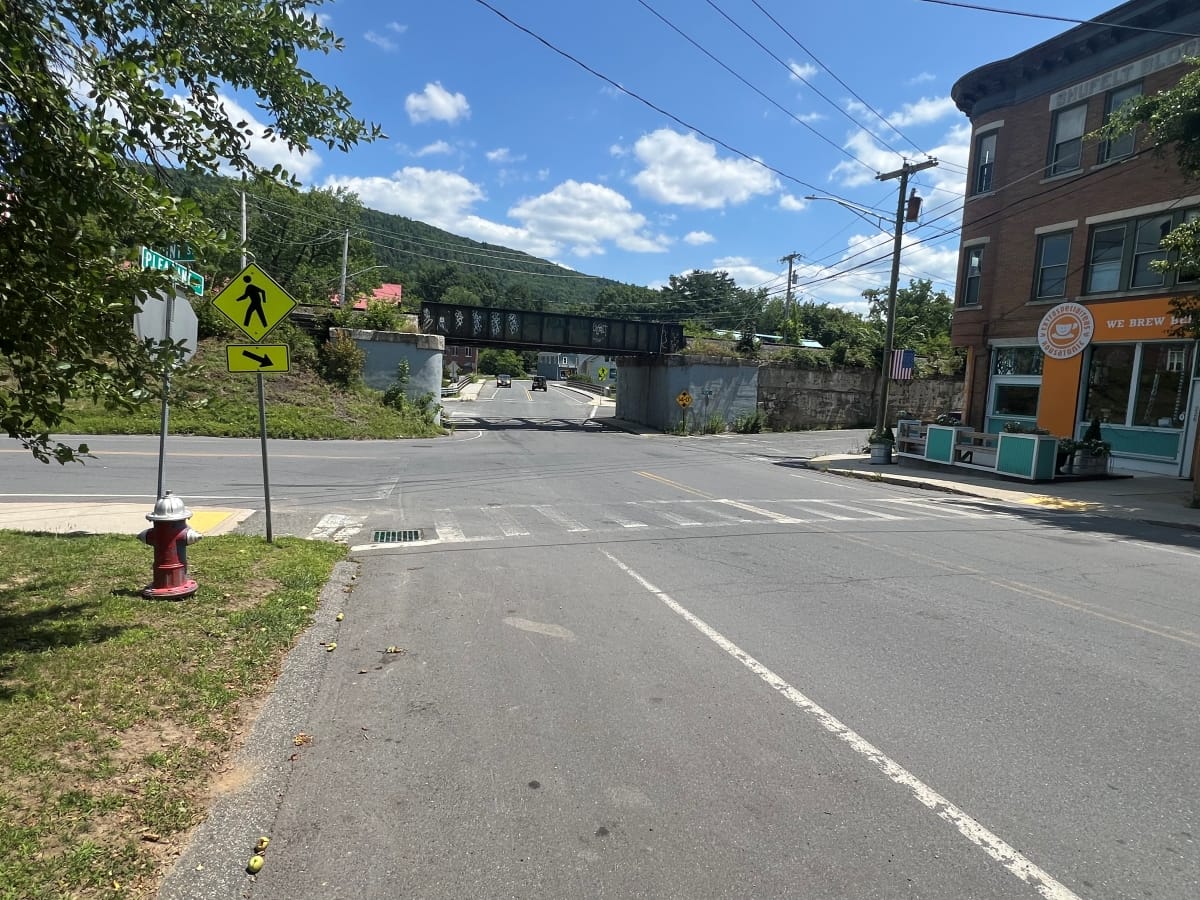
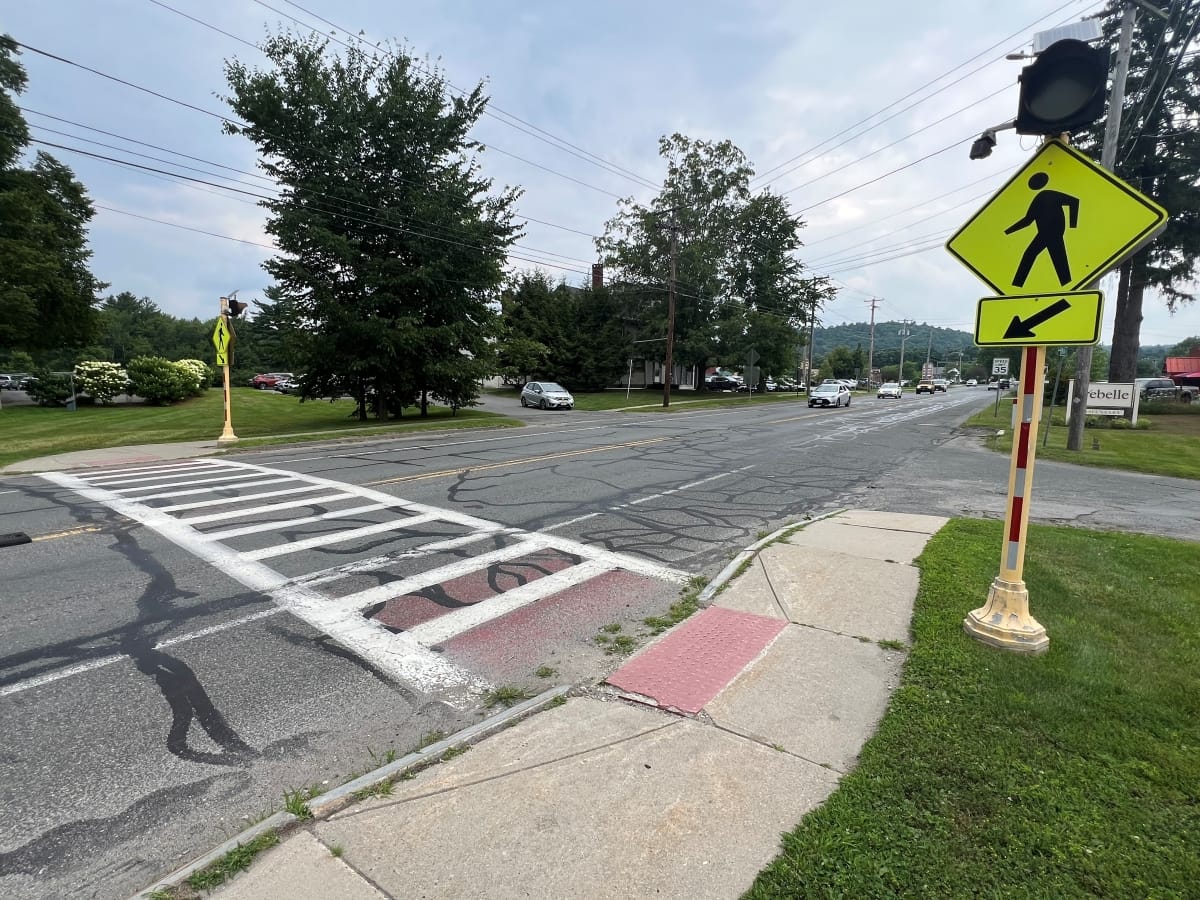
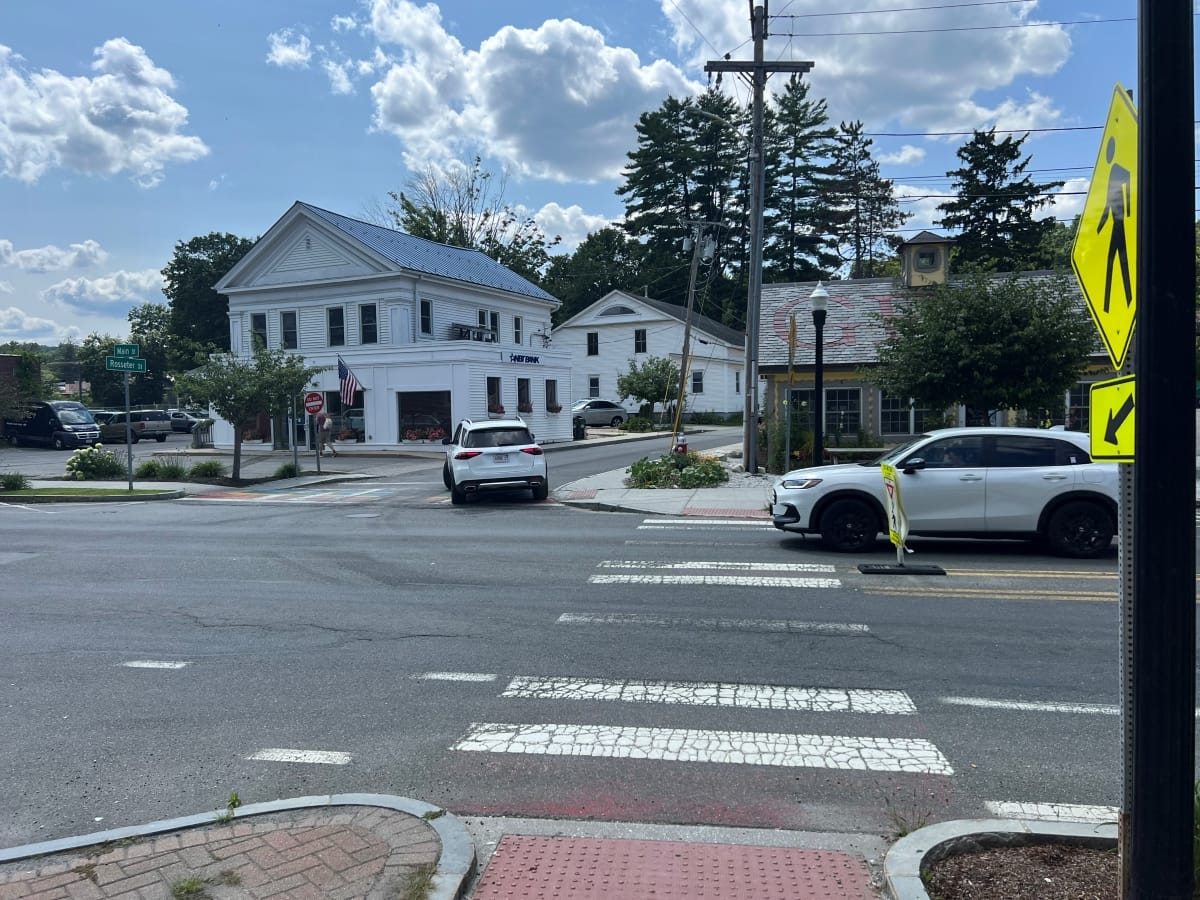
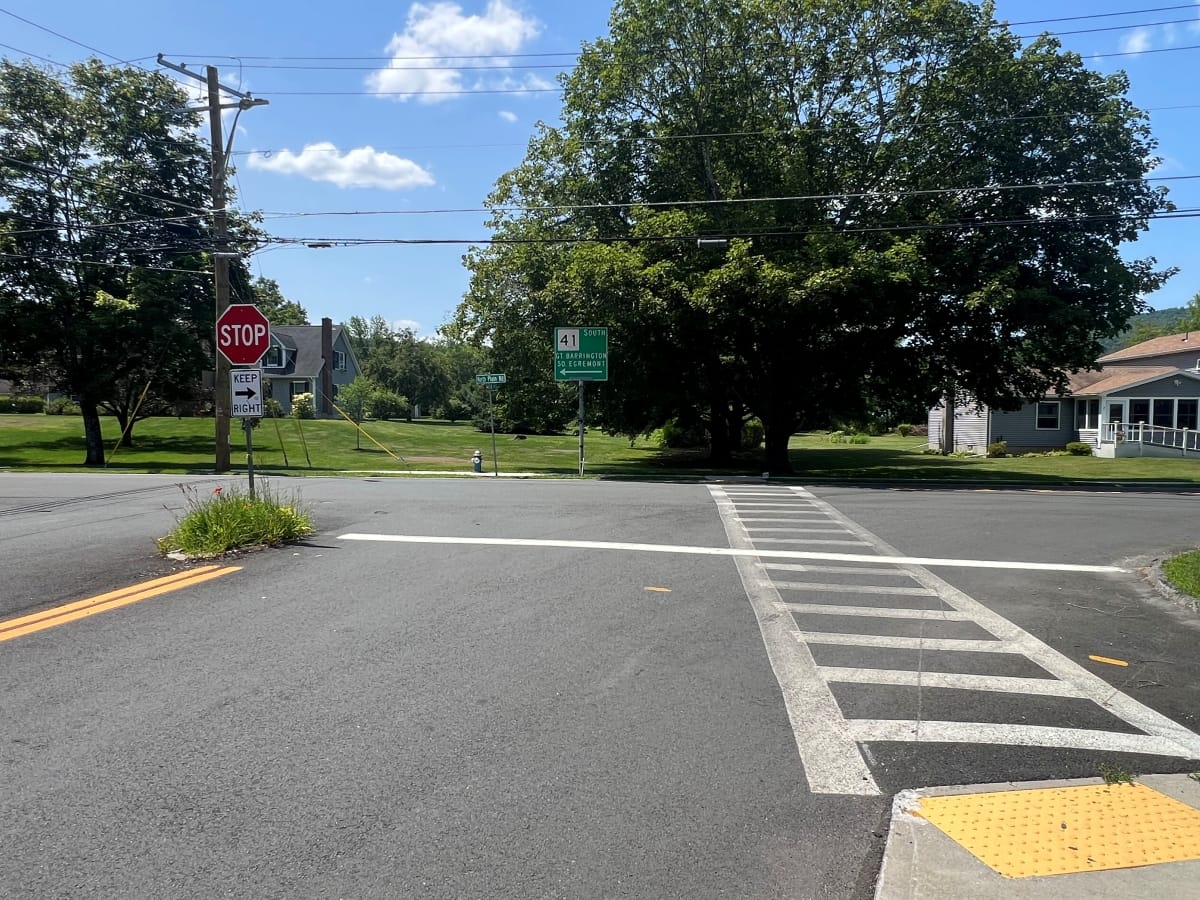
Five locations in Great Barrington were chosen to receive modern crosswalk assemblies (clockwise from top left): Bridge Street at the Housatonic River Walk; Front and Pleasant Streets in Housatonic; Reed Street at South Main Street; North Plain Road and Main Street in Housatonic; and Rosseter Street at Main Street. (Bill Shein/RGM)
The uninstalled replacement fits a longer pattern on South Main Street: repeated declarations of urgency followed by limited action. Town officials have described pedestrian safety there as a priority since at least 2018, when Great Barrington proposed a seven-million-dollar, federally funded overhaul that would improve about a mile of roadway, add sidewalks, upgrade crosswalks, and introduce traffic-calming measures.
But the project stalled after the town did not fund the engineering and design work needed to advance it. E-mails obtained through a 2024 public-records request show that MassDOT project managers repeatedly pressed the town for action over nearly two years.
The proposal also had substantial public support. In a 2018 survey that drew more than 300 responses, the South Main Street overhaul ranked as Great Barrington residents’ third-highest priority for possible funding through the state’s Complete Streets program.
 Bill Shein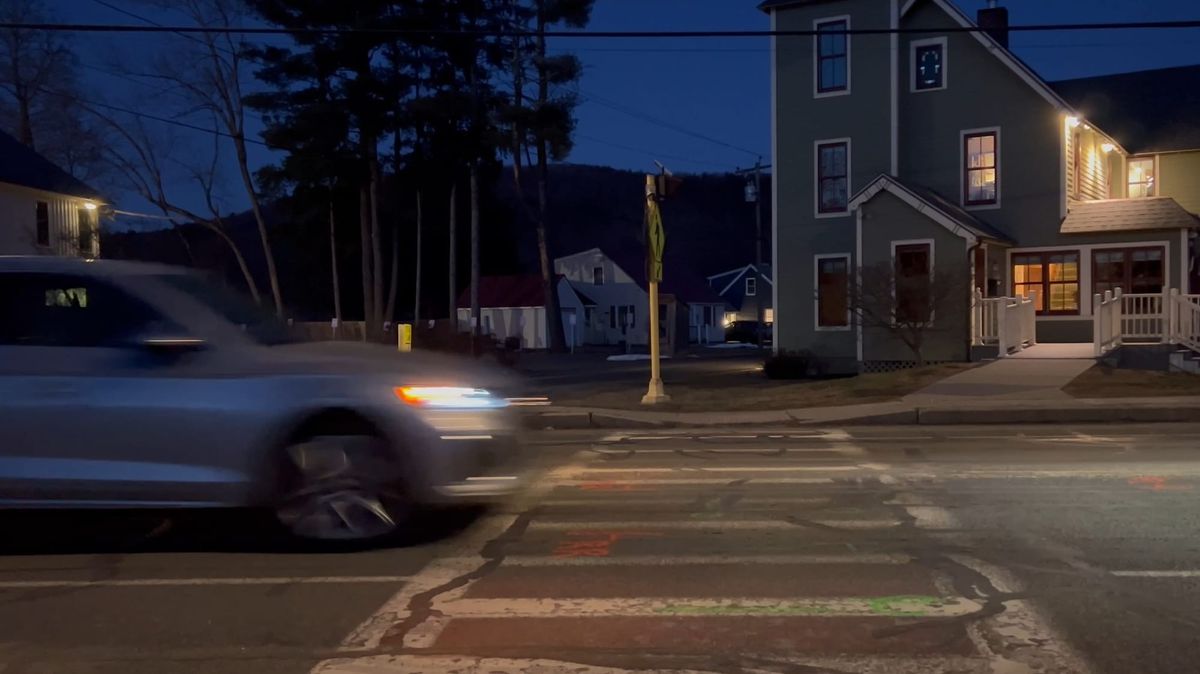
In 2024, former Town Manager Mark Pruhenski proposed spending $3.5 million on a smaller package that included upgraded crosswalks and new sidewalk connections. Citing a tough budget year, members of the Select Board and Finance Committee removed it from the spending plan.
Since then, other than new pavement markings and signs, little has changed—despite repeated acknowledgments that the corridor needs attention.
After Fretwell’s death, Select Board member Phil Orenstein—who also chairs the Great Barrington Housing Authority, which oversees Brookside Manor and other public housing—said South Main Street safety issues were “being taken very seriously” by the Select Board, according to minutes of a February 2 Housing Authority meeting.
At a June 1 joint meeting of the Select Board and Planning Board, Orenstein said he had “grave concerns” about speeding and safety on South Main Street. “What do we need to do to enable us to be more proactive and move more quickly in implementing some changes?” he asked during a discussion of pedestrian-safety priorities.
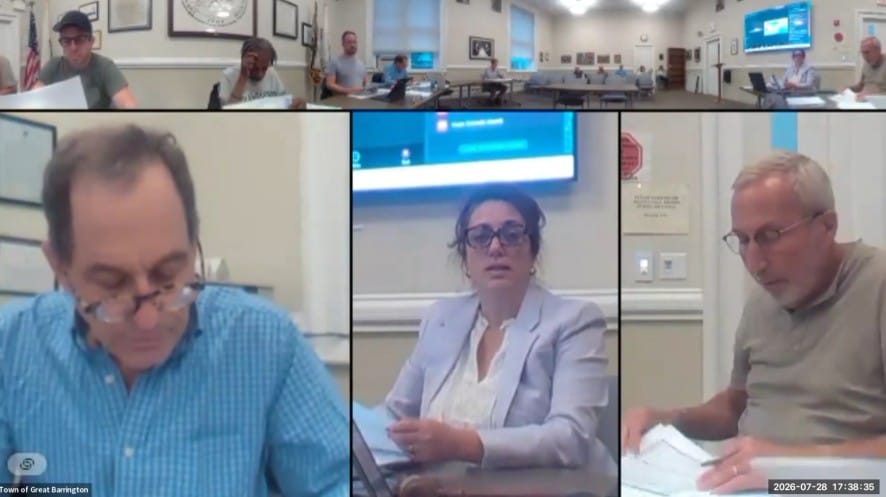
Select Board Chair Steve Bannon, who was first elected to the board in 2010 and has served as chair since 2018, said members lacked the expertise to determine which pedestrian-safety measures should be prioritized. “We ask the staff to come back to us with recommendations,” he told Orenstein, suggesting that the town’s financial and staffing constraints limit what can be treated as a priority.
Bannon was aware of the urgency two years earlier. In a January 2024 interview, he told me that South Main Street’s safety issues should be addressed “sooner rather than later.”
In this case, however, the town was not waiting for a recommendation, a design, or money to purchase the equipment. MassDOT had already delivered the Reed Street replacement, and voters had approved funding to install all five crosswalk assemblies at this year’s Annual Town Meeting.
In response to e-mailed questions, Bannon and Orenstein both declined to comment. Hartsgrove did not respond to e-mailed questions and a telephone message seeking comment on the continuing malfunctions, the town’s maintenance and testing of the existing system, why the replacement equipment had not been installed, or whether the town had requested an extension from MassDOT.
Yet at Tuesday’s Select Board strategic-planning meeting, Hartsgrove again identified the corridor as a priority. “South Main Street is the top priority for crosswalk improvements,” she said.
Hartsgrove also said the town must ensure that its safety equipment functions properly.
“Making sure the technology we use is actually working, that is the most important at this time,” she told the Select Board. “Making sure that it’s operating the way it’s supposed to is the town’s responsibility.”


