

Earlier this year, Cameron Cunningham, a Pittsfield city councilor and engineer at General Dynamics Mission Systems, offered a surprisingly candid description of the local defense economy.
“For better or worse,” he told me, emphasizing that he was not speaking for his employer, “war is good for business. And it doesn’t seem like we’re getting any less wars.”
Six months later, that business continues to be quite good.
On September 3, the United States Navy finalized a $194.1 million contract with Cunningham’s employer to develop the fire-control system for a new nuclear-armed, sea-launched cruise missile known as the SLCM-N. Seventy-five per cent of the contracted work will be done in Pittsfield, which translates to about $146 million. That total includes a preliminary $36.2 million contract awarded in February.
It comes on top of an extraordinary run of nuclear-weapons-related contract awards here over the past few years that I detailed in a March investigation, Welcome to the (Nuclear) Berkshires.
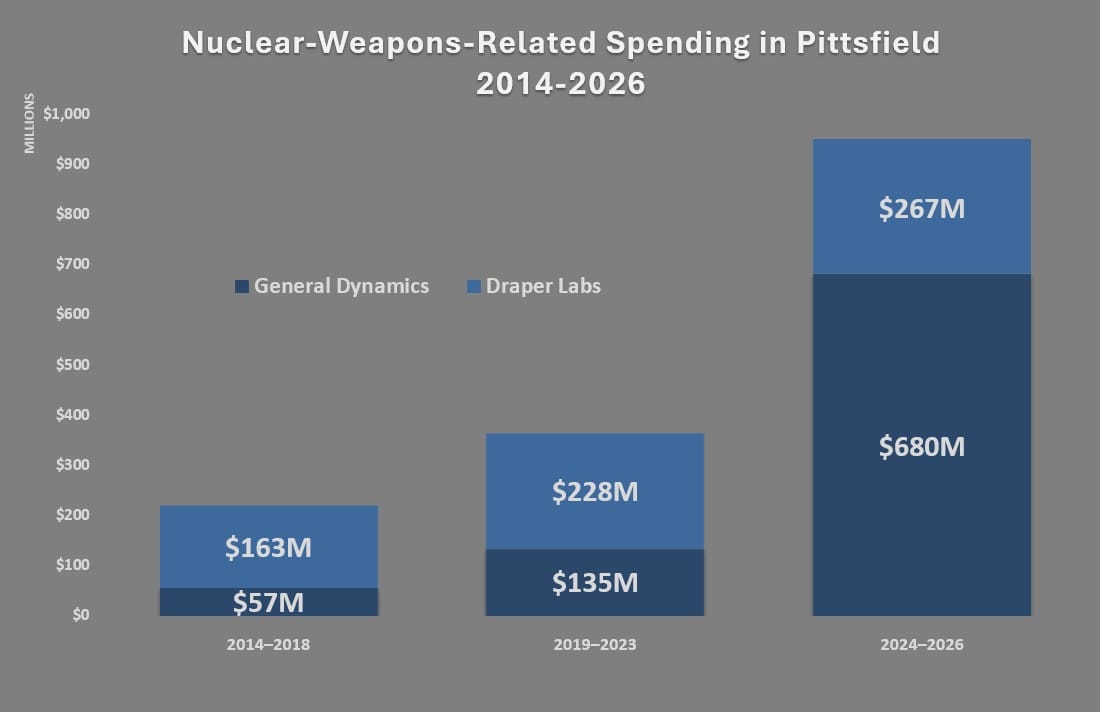
My earlier review found $812 million in nuclear-related contract awards made to General Dynamics and Draper Labs in Pittsfield from January 2024 through February 2026.
Adding the SLCM-N increase and other nuclear-related awards since then brings the two-and-a-half-year total to almost $948 million—just shy of $1 billion for nuclear-weapons work in the Berkshires.
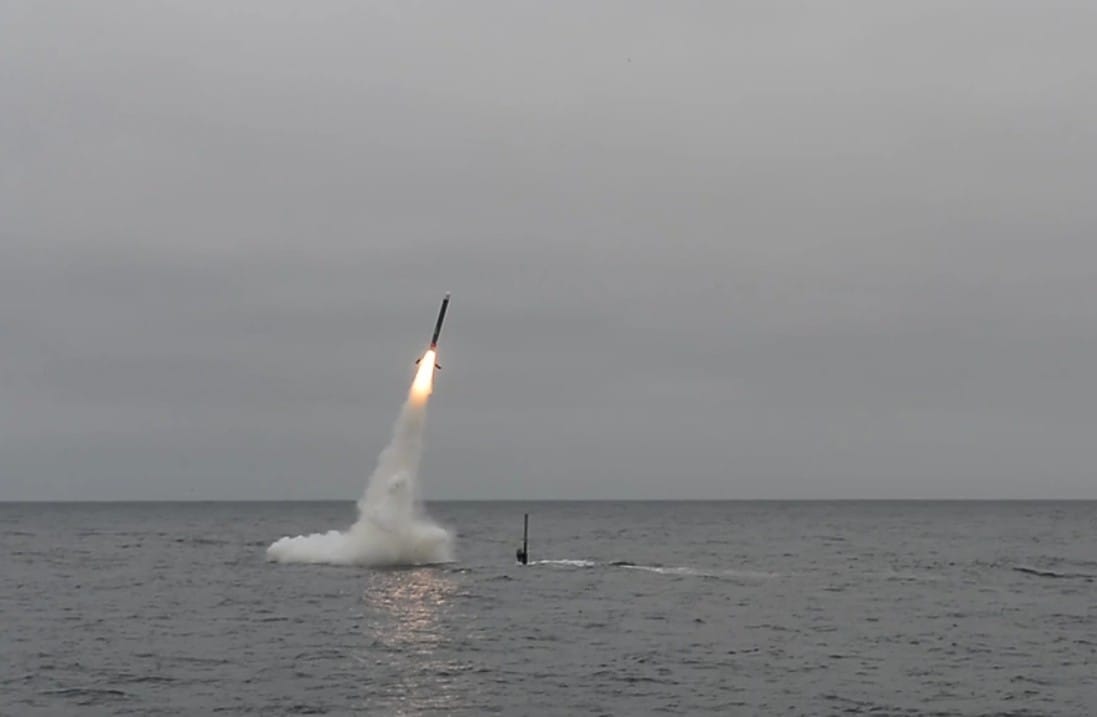
The SLCM-N program has had an interesting journey. The Navy deployed a nuclear-armed version of the Tomahawk beginning in the mid-nineteen-eighties; President George H.W. Bush withdrew those missiles by mid-1992.
The first Trump administration proposed developing a sea-launched nuclear cruise missile that would be carried aboard attack submarines. A few years later, when the Biden administration tried to cancel it, Congress funded it anyway.
Now the current Trump administration is accelerating development, and a chunk of that work has arrived in the Berkshires.
Supporters argue that a lower-yield nuclear weapon aboard an attack submarine gives the president a more flexible nuclear option, short of using the large strategic weapons delivered by land- or submarine-based missiles or dropped from bombers. Critics see that flexibility as enormously dangerous, arguing that nuclear weapons designed to be more “usable” lower the threshold for nuclear war.
Massachusetts Senator Ed Markey has repeatedly opposed SLCM-N for precisely that reason, even as the program is now bringing new jobs to his state. Along with fellow Massachusetts Senator Elizabeth Warren, he co-sponsored an unsuccessful 2021 bill that would have blocked all spending on the SLCM-N.
Those jobs are already arriving in Pittsfield, with more to come. One recent GDMS job posting for the SLCM-N program describes an opportunity to help build it “from the ground up.”
Work on the SLCM-N is only part of what increasingly looks like a long-term expansion of GDMS’s nuclear-weapons-related business in Berkshire County. Procurement documents published this spring show that the Navy will soon award another large sole-source contract to GDMS for work beginning in October 2027. It will extend the company’s decades-long work on Trident nuclear-missile systems to the new Columbia-class ballistic-missile submarines, Britain’s Dreadnought-class submarines, next-generation Trident systems—and whatever comes after that.
As a result, the defense-related hiring machine is humming at what appears to be full speed. As of yesterday, GDMS listed 192 open jobs in the Pittsfield area, up from 120 earlier this year—a sixty per cent increase in active listings since my earlier reporting.
Those open positions span the full range of the company’s programs: SLCM-N, strategic-missile systems, nuclear-weapons security and safety, next-generation Trident work, manufacturing, software, engineering, internships, and entry-level positions.
Last week, GDMS spokesman Joe Sowers told me the company’s plan to grow its Pittsfield workforce from sixteen hundred employees to about two thousand by 2028, which he first shared with me in March, has not significantly changed. He said the company had already anticipated these new contract awards.
There are other signs of permanence in the list of recent contract announcements, including a $15.4 million award to General Dynamics this spring for ongoing maintenance and improvements at the Navy-owned Pittsfield facility that supports the Trident II nuclear-missile fire-control program, and another $27 million award in August for continuing Pittsfield work on Littoral Combat Ship systems. Cambridge-based Draper Labs also received a few million dollars more for its work in Pittsfield on submarine-launched missile-guidance systems.
All of the nuclear-weapons work is part of the U.S. military’s massive “nuclear modernization” project, a decades-long effort that began in 2010 and is expected to cost at least $1.7 trillion, as the military upgrades or replaces every element of the nation’s land, sea, and airborne nuclear forces.
That total leaves out spending on a proposed “Golden Dome” missile-defense shield that the nonpartisan Congressional Budget Office said could cost $1.2 trillion over twenty years. Many analysts question whether such a system is technically feasible at anything approaching the proposed scale; it could also further accelerate a brewing nuclear-arms race with Russia and China.
The overall defense-spending trajectory is, as Siskel and Ebert might have put it, going “up, way up.” The Trump administration is seeking $1.5 trillion in total defense spending for the budget year beginning this October, more than forty-four per cent higher than this year.
You might think someone in the Berkshires would occasionally mention all this. Or, at minimum, that hundreds of new jobs would generate local headlines, regardless of the industry.
But the only Berkshire Eagle story about GDMS’s Pittsfield operations since my March reporting was about an electrical fire and brief evacuation of its facility in late April. (The paper has not published anything about nuclear-weapons-related contracts in Pittsfield since 2022.)
The story included one especially puzzling description. Readers were told that General Dynamics workers “primarily manufacture advanced electrical and power distribution systems for U.S. Navy vessels.”
Well, I suppose that’s one way of putting it.
They also design, build, and support systems used to launch and direct submarine-launched nuclear missiles to their targets, work on nuclear-weapons security, and are now helping create a new nuclear cruise-missile program that critics warn could make nuclear war more likely.
Labeling all of that as “advanced electrical and power distribution systems” is accurate in the same way that calling a nuclear-armed submarine “a little underwater boat” is accurate.
 Bill Shein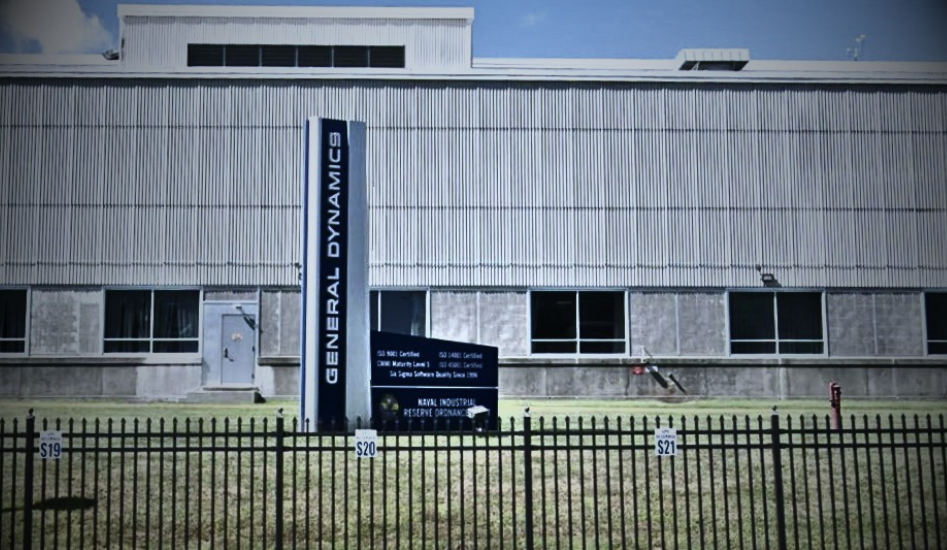
I don’t mean to pick on the Eagle, where I contributed a column for many years and which, under energetic local ownership for the past decade, continues to succeed as many legacy newspapers give up the ghost. (Though, as I explained in March, editors under the paper’s previous ownership did once spike a column of mine about General Dynamics.)
But in this case, the blind spot is emblematic of one of the stranger aspects of the Nuclear Berkshires: a region that wears its progressive politics on its collective sleeve has become an ever-more-important outpost of the American nuclear-weapons establishment, largely without any meaningful community discussion about what that means—or the kind of sustained media coverage that might help spark one.
Meanwhile, at a geopolitical moment best summarized by the phrase “growing instability,” fears of a wider global war—and even the possible use of nuclear weapons—are spreading. More nations may seek nuclear weapons of their own as the Trump administration pressures its allies in Europe and the Indo-Pacific to assume more responsibility for their own defense—and as the president gestures toward Russia in ways that have unnerved NATO members.
Wartime rhetoric from President Donald Trump and Russian President Vladimir Putin has done little to calm those fears.
Early in the war he launched in the Middle East, Trump warned that “a whole civilization will die tonight, never to be brought back again” if Iran did not make a deal he found satisfactory.
Last Sunday, speaking to a Fox News reporter about the war, he said he was preparing to decide “if and when do I blow the entire nation up.”
And this week at the United Nations, he said, “Will a deal be made with Iran that lets them rebuild and create a far greater country than it ever was before … or do I annihilate the Islamic Republic, and do it quickly?”
The statements did not explicitly threaten the use of nuclear weapons, but that’s still what many heard. Others dismiss his threats as negotiating bluster or Trump’s version of the Nixonian “madman theory.”
Regardless, they come from the person with sole nuclear-launch authority in a country that has never ruled out the first use of nuclear weapons and that remains the only nation to ever use them in war. Trump is seen—by his critics and even by supporters—as rash and impulsive. He can also sound megalomaniacal: in January, he told The New York Times that he sees no limit to his power, and said he feels unconstrained by longstanding treaties or international law.
A simulation of the effects of a three-hundred-kiloton nuclear explosion above the General Dynamics facility in Pittsfield. As a military-production facility, it could be targeted. (Outrider Foundation)
Meanwhile, the Pentagon is embedding artificial intelligence deeper into military operations, including systems connected to nuclear planning and decision-making. That has accelerated worries not only about machines making life-and-death decisions, but also about A.I. distorting information and encouraging humans—who may be under enormous pressure—to simply trust what an A.I.-enabled computer tells them.
Indeed, mistakes and miscalculations are already the stuff of nuclear nightmares; they have brought the world close to catastrophe before. Anyone who uses A.I. is also familiar with that cheerful little warning: “ChatGPT can make mistakes. Check important info.” Whether an incoming missile attack is real, or a catastrophically misunderstood flock of geese, would seem to top any list of “important info.”

While Cunningham, the city councilor, said “war is good for business,” he also expressed a rock-solid belief that nuclear weapons, and the trillions of dollars spent on them, have prevented war among major powers. But longtime anti-nuclear-weapons activists I’ve interviewed, including those with the Back from the Brink campaign and the International Campaign for the Abolition of Nuclear Weapons, argue that deterrence is a dangerous, risky gamble.
For now, with remarkably little awareness or discussion, more of America’s nuclear-weapons complex is putting down roots in the Berkshires alongside the liberal Brooklyn hipsters arriving to renovate old Victorians and retirees settling full-time into their former weekend homes.
You’re unlikely to see this element of the local economy described in a “Visit the Berkshires!” tourism brochure or featured on the cover of any of the region’s growing stable of glossy, high-end lifestyle magazines.
But that doesn’t mean it isn’t here—or that it isn’t growing.


