

So, while others were spending time playing with their kids, writing novels, or learning Italian, I went back to the South Main Street crosswalk in Great Barrington several times last week—and then a couple more times this past weekend.
Why? Because apparently this is my life now: noting traffic patterns, observing pedestrian habits, and standing on the side of the road waving my arms to test whether I’m seen by an oft-broken motion sensor.
Once again, I found that the sensor on the west side of the Reed Street crossing—which is supposed to detect a pedestrian and activate flashing warning lights for motorists—does not function properly.
This time, though, I found that it may not be entirely broken. Sometimes it worked. Sometimes it didn’t.
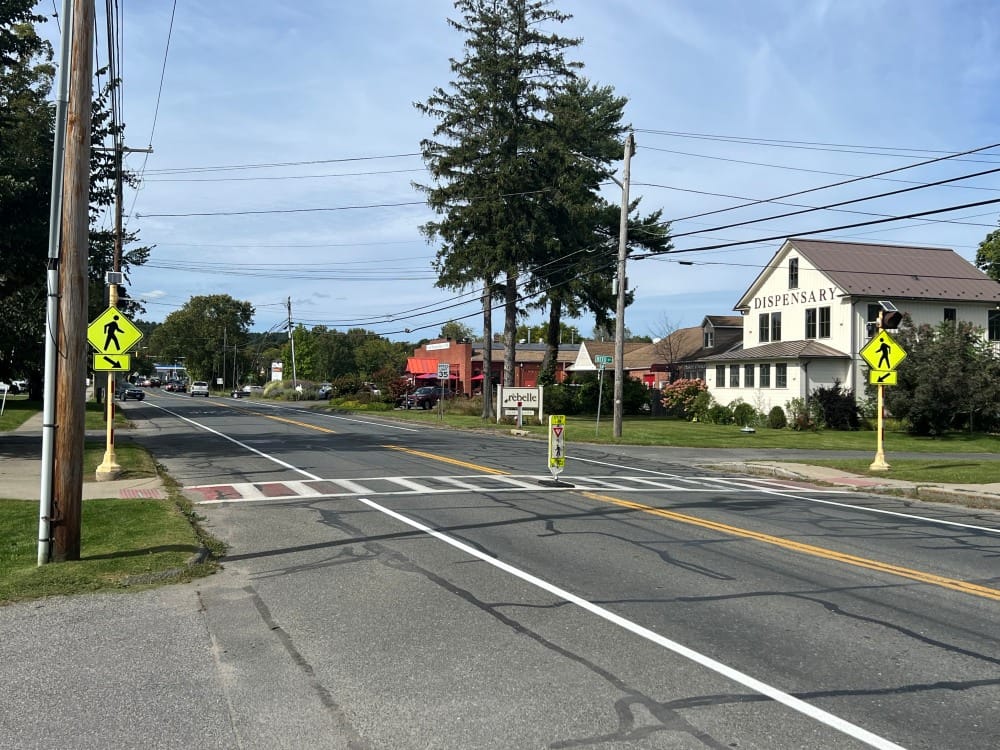
Over the years, I’ve found that, if it works at all, it depends on some unknown combination of pedestrian height, walking speed, time of day, weather conditions, sun angle, moon phase, Mercury’s position relative to the Oort Cloud, maybe hair color, and perhaps whether the sensor woke up that morning feeling cranky, bored, or appreciated.
The current state of affairs may actually be worse than when it doesn’t work at all. Now? Maybe it saw you. Maybe it didn’t. Maybe drivers see flashing lights. Maybe they don’t.
Recall, unfortunately, that this crosswalk is where seventy-year-old Brookside Manor resident Gary Fretwell was struck by a pickup truck just after sunset on January 13. He later died from his injuries. Police investigators found that the west-side motion sensor was not functioning at the time of the accident.
After the crash, Great Barrington Town Manager Liz Hartsgrove said the broken sensor had been repaired and fully tested. She also promised “immediate crosswalk improvements” for that part of town, where hundreds of residents live in income-qualified and senior housing.
One vital improvement was already on its way. The previous summer, Great Barrington had signed an agreement with MassDOT for five new Rectangular Rapid Flashing Beacon crosswalk systems, or RRFBs, provided at no cost to the town.
MassDOT spokesman John Goggin described the federally funded program as one that supplies “quick-turnaround materials” to improve safety and reduce pedestrian fatalities while communities work on longer-term infrastructure improvements (emphasis added).
 Bill Shein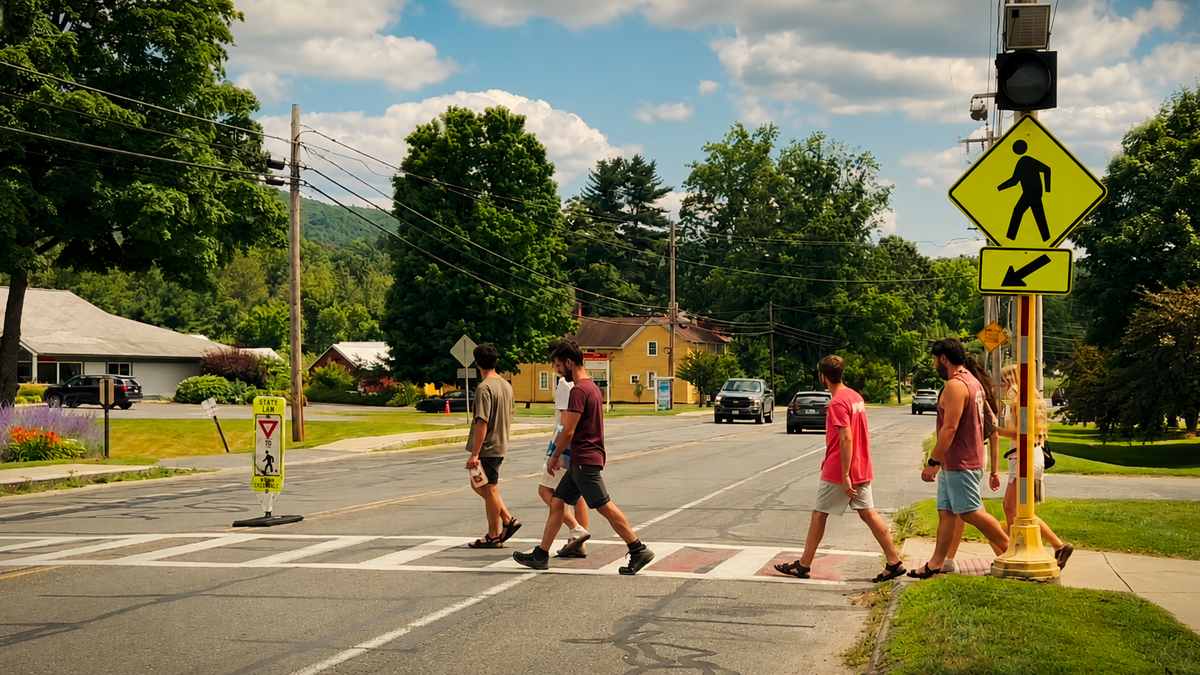
Those five systems were delivered to Great Barrington on April 24, Goggin told me this summer. Under terms of the signed agreement, the town was supposed to install them within ninety days—including one at South Main and Reed Streets.
So far, none have been installed.
Project paperwork suggests South Main would be the easiest of the five. A July 2025 engineering assessment prepared for the town found that the existing curb ramps at the crosswalk “appear to be ADA compliant” and said the new RRFB could be installed on the foundation used by the existing system.
At the same time, MassDOT’s project checklist, attached to the agreement, identified precisely zero prerequisite work at the site. It was ready to go. An electrician’s quote put the South Main installation cost at just $6,100—the least expensive of the five locations—because the existing foundation could be reused.
Yet here we are. Five months later, the new equipment remains uninstalled, while the moody, intermittent system remains in place on a dangerous stretch of South Main Street where three pedestrians have died since 2006. All three were residents of the Brookside Manor senior apartments.
And, as we learned last month, the People’s Pantry is relocating this fall to the former Rebelle dispensary building at that very intersection, likely bringing a burst of pedestrian and vehicle traffic during concentrated periods at least a couple of times each week.
That coming change is important to keep in mind. Because at last week’s Select Board meeting, Hartsgrove didn’t announce that the faulty equipment had finally been replaced with the MassDOT-provided RRFB system, eight months after a fatal crash.
Instead, she unveiled additional ideas for the South Main Street crosswalk: bump-outs, a raised crosswalk, rumble strips, and other improvements.
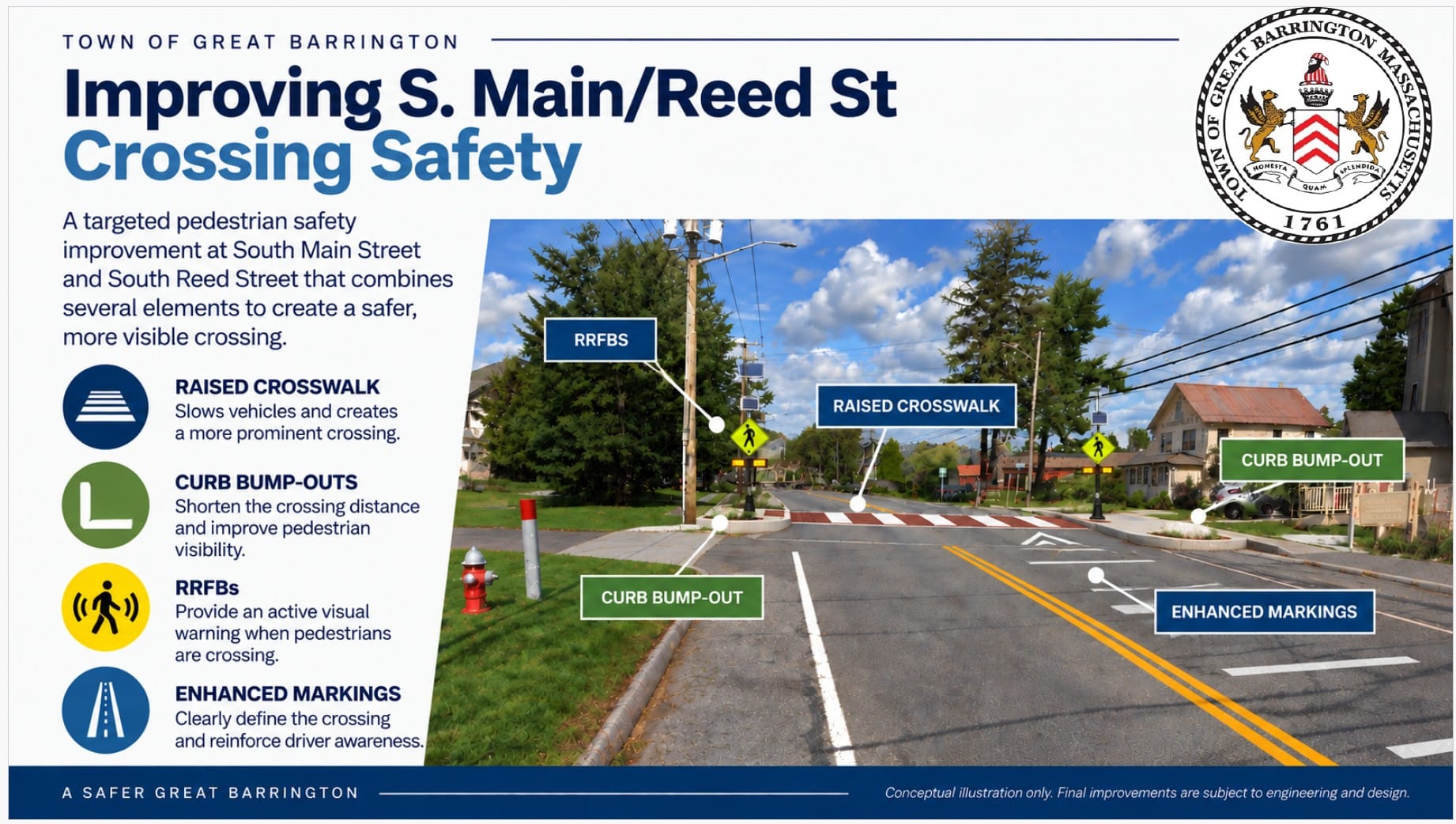
Those are certainly worthwhile. Indeed, they are long overdue and reminiscent of a plan for more than a mile of South Main Street reconstruction that has been kicking around without progress since 2018, and that I’ve reported on repeatedly. That plan includes new and upgraded crosswalks, reconfigured roadways, new and improved sidewalks, traffic-calming features, and more.
But the “quick-turnaround” RRFB installation—certainly an “immediate crosswalk improvement,” to borrow Hartsgrove’s January phrase—has now been folded into a larger five-crosswalk redesign project that will require design, engineering, bidding, and construction phases, for which she offered no timetable.
Replacing the faulty warning system at the site of January’s fatal crash has, once again, been deferred.
Hartsgrove did say that design work would begin on that major, mile-long reconstruction project, which has been repeatedly delayed and allowed to stall. Realistically, though, securing federal funding and advancing it to construction is, at best, several years away.
Without apparent irony, the document describing the new plan includes a bold-enhanced tagline, “Improve pedestrian safety now. Build the foundation for a larger South Main Street investment.”
But when exactly is “now”? And what happened to “immediate”? Does simply replacing one faulty crosswalk-warning system after a fatal crash now require an understanding of Einstein’s theory of general relativity?
The town manager’s presentation then took another curious turn. Hartsgrove told the board that she was now “concerned” about the $171,000 voters had already approved for the five RRFB installs because, she said, “That number was given to me by the previous engineer and [public works] superintendent, and there is no backup material on how that number came about.”
In fact, there appears to be quite a bit of backup.
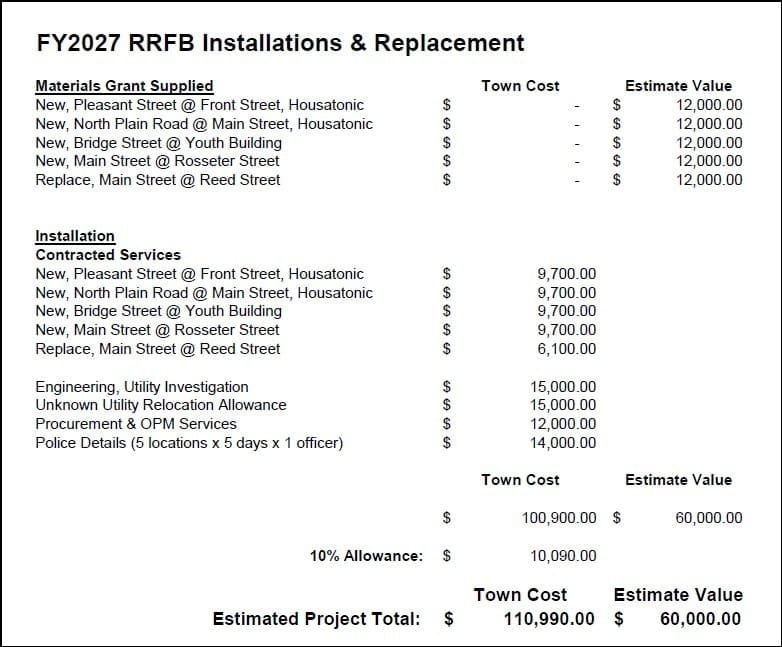
Her own FY2027 capital-budget book includes several dozen pages on the project, including the MassDOT agreement, the 2025 engineering assessment, an electrical contractor’s $44,900 quote, and the overall project-cost summary. Town expenses: $110,990. MassDOT-supplied equipment: a grant worth about $60,000, listed as a budget offset. Total project: $170,990.
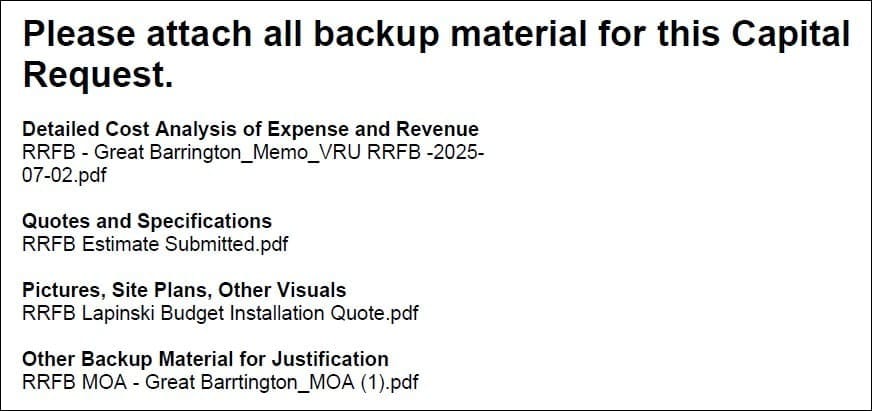
In other words, the same $171,000 listed throughout the budget documents as the “Town Manager Recommendation,” which was approved by two town boards and then by voters in May, is a number—and a project—that Hartsgrove now says lacks backup.
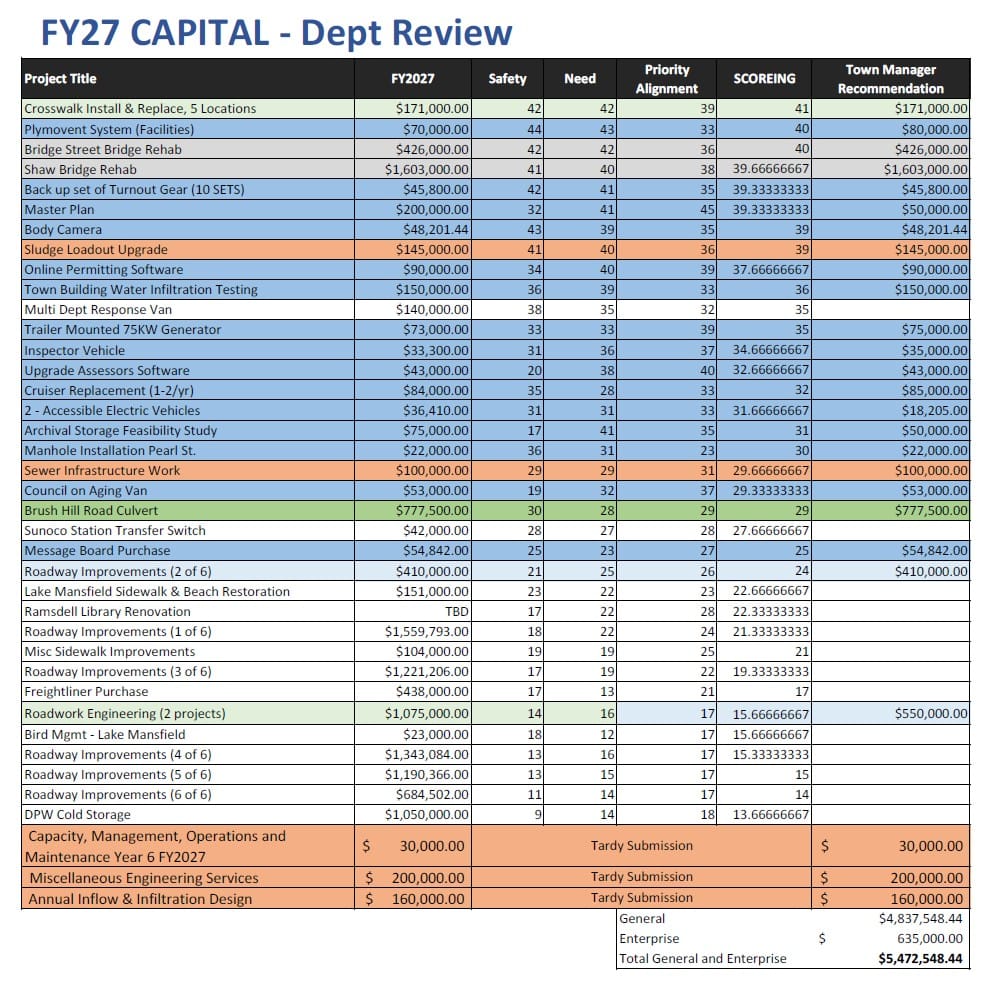
For the budgeting nerds still with me, recall that Hartsgrove instituted a new capital-budget process this year that required departments to submit a “FY27-31 Capital Request Form,” attach detailed supporting documentation, and have their requests reviewed and anonymously scored by department heads across town government.
Speaking to the Select Board and Finance Committee on April 7, Hartsgrove explained that the scoring followed a full-day meeting of all department heads at which each capital proposal was presented and justified.
Wondering which project ranked first? You guessed it: “Crosswalk Install & Replace, 5 Locations, $171,000.”
Hartsgrove did not respond to several e-mails last week asking about all of this, including whether she meant some other missing documentation when she said there was “no backup” for the RRFB installation project.
Goggin, the MassDOT spokesman, did not answer questions last week about whether the town’s new, longer-term plan complies with the RRFB program requirements and contract obligations. He previously told me that MassDOT was confident the equipment would be installed, but would not say whether the town had requested, or received, a deadline extension.
(For the aforementioned budget nerds, here is a single PDF of the full backup package for the project. You’re welcome.)
For its part, the Select Board endorsed Hartsgrove’s new plan unanimously, 5-0. None of its five members asked about the still-malfunctioning equipment or ongoing risks to pedestrians while the new “Improve pedestrian safety now”-tagged plan moves through its various stages.
Nor did anyone ask about a timeline—despite having heard, just minutes earlier, about the People’s Pantry’s coming move, including from its vice president, Silke Aisenbrey, who told the board bluntly, “The existing crosswalk is not safe.”
Select Board Chair Steve Bannon did ask about improving lighting at the crosswalk. “It’s really dark down there,” he said. Hartsgrove replied that “the budget didn’t include lighting” and said it would instead be considered as part of a future project.
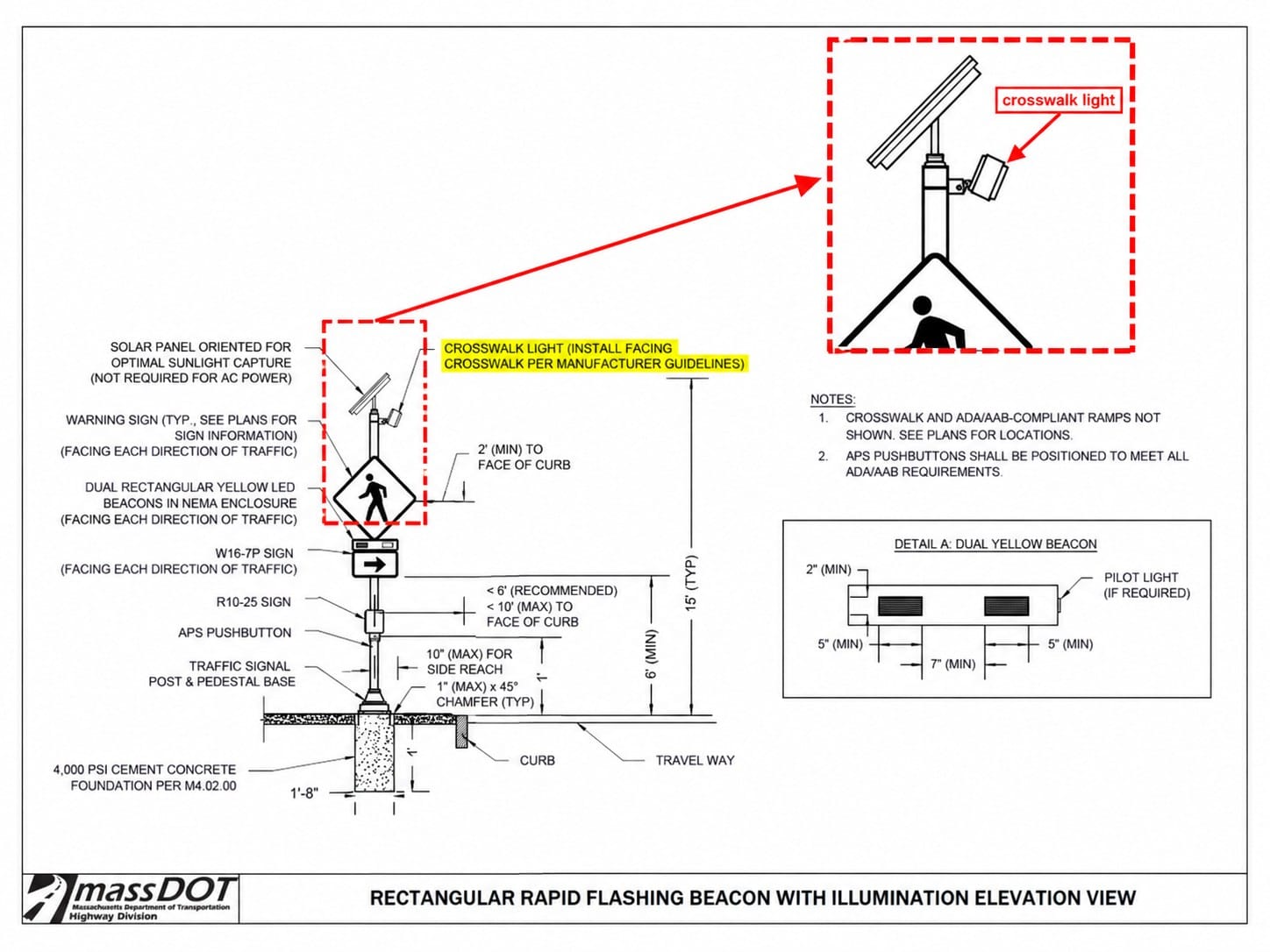
That exchange caught my ear. Because according to MassDOT—and the actually existing backup documents—the RRFB systems already provided to the town include built-in overhead lighting that illuminates the crosswalk at night.
Oh.
Good to know.
Well, afraid that’s all the time we have today for this increasingly bonkers story about how a broken, outdated crosswalk-warning system has still not been replaced eight months after a fatal crash.
Stay tuned for the next installment of Bill Shein’s Crosswalk Corner™, when I’ll consult linguists, physicists, political scientists, time travelers, and other experts to determine whether the Great Barrington government’s definitions of “immediate” and “now” have any relationship to space and time as ordinarily understood.
Until then, be careful out there.


