

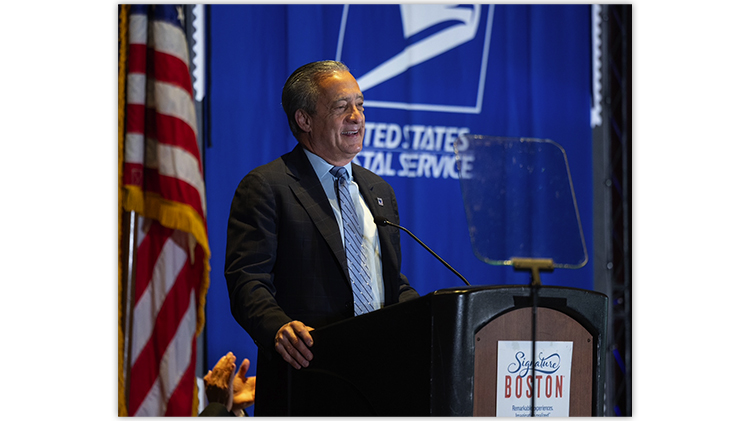
At the opening session of the 2026 Boston World Stamp Expo last weekend, David Steiner, the United States postmaster general, began with a line guaranteed to delight a ballroom overflowing with stamp collectors. One of his goals, he said, was to “reinvigorate stamps for a broader public, and especially for younger people.” The room erupted in applause and cheers.
Then he kept going.
Reading prepared remarks from a teleprompter, Steiner said he wants Americans to see stamps “not as analog or as distant relics of the past, but as current and meaningful.” Why, he asked, should a stamp tell us only who we were, and not where we are now? In selecting what to put on its stamps, the United States Postal Service, he suggested, should “consider whether certain rules still match the moment.”
The rule he had in mind is one of the quiet customs of American postal life: the longstanding practice of not putting living people on U.S. postage stamps. More than a year into the second Trump administration, those in the room were immediately aware of what that change could mean.
Like all presidents, Donald Trump will someday appear on a commemorative stamp issued by the U.S.P.S. Former presidents are customarily honored after their lifetime—but not before. The principle has roots in an older American discomfort with putting living leaders on public symbols of state power. Current presidents have generally not appeared on circulating coins or paper currency, either; the habit smacks of monarchy, something the American Revolution, now approaching its two hundred and fiftieth anniversary, aimed to leave behind.
But during a presidency marked by aggressive efforts to place Trump’s name, likeness, and signature on instruments of government—from the huge banners hanging on the Department of Justice, to commemorative passports, a proposed semiquincentennial dollar coin, and a legislative push for a $250 bill bearing Trump’s glowering image—Steiner’s remarks raised an unavoidable question: Is the Postal Service preparing to issue a Trump stamp?
In his speech, Steiner’s example of a modern, “culturally relevant” living subject was not Trump but the U.S. men’s hockey team and its gold-medal victory at this year’s Olympics. In particular, he pointed to a key save by goalie Connor Hellebuyck. “I thought that picture should be a stamp, and why shouldn’t it be?” he asked. He said the moment got him thinking about the living-person rule because it happened not long after he was named postmaster general in May, 2025.
He also told expo attendees that stamps “reflect the country back on itself,” and vowed to champion efforts to put living people and recent events on stamps to “more boldly honor the present and the future.”
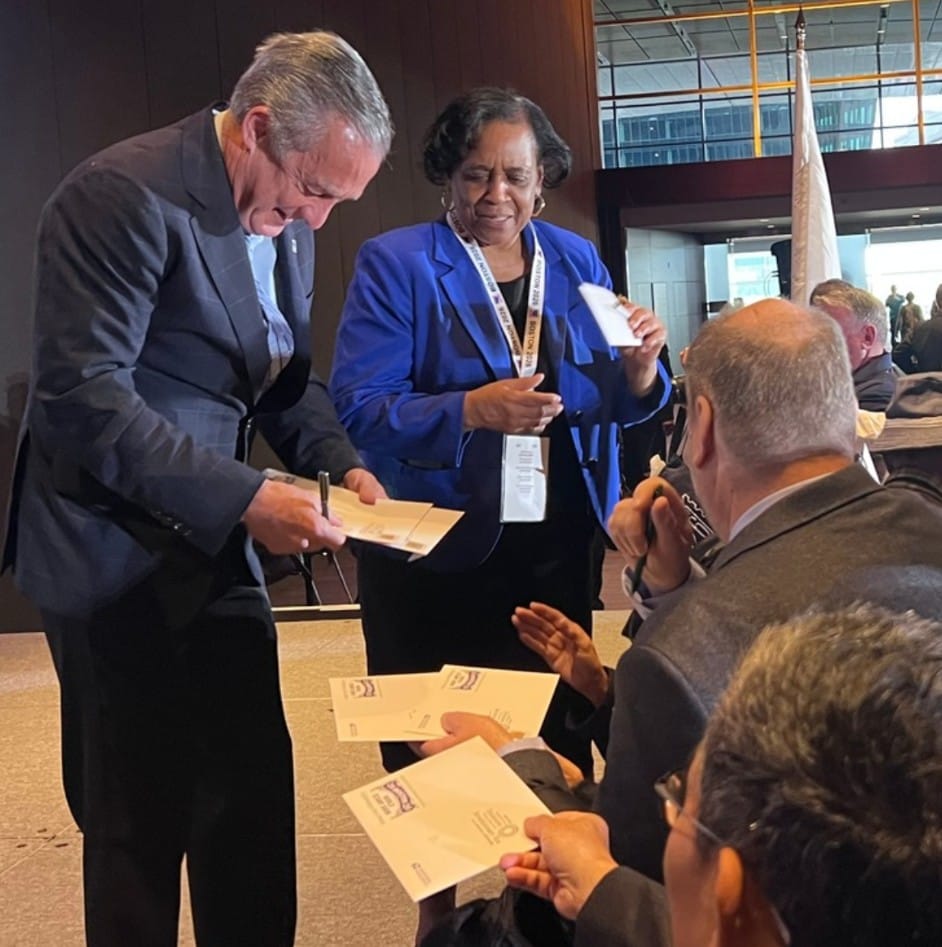
When Steiner left the podium, I asked him if his comments were meant to lay groundwork for a Trump stamp. “I’d rather do Taylor Swift and Travis Kelce,” he said with a laugh, referring to the pop music mega-star and her football-player fiancé.
When I pressed him, Steiner insisted that no subjects have been discussed or considered. “Honestly, we haven’t talked about any of it yet. Today was just something I wanted to announce to make sure folks realize that we do have the option to do that,” he said. After starting the job, he said, the possibility of living people on stamps “was one of the first things I looked at.”
At present, there is no evidence that a Trump stamp is in production or under formal consideration. The White House did not respond to a request for comment.
While keeping living people off stamps has been the policy of the Citizens’ Stamp Advisory Committee for much of the time since it was established, in 1957, to review and recommend stamp subjects, Steiner is correct that it’s not written in law.
CSAC, which is pronounced “see-sack,” is made up of artists, designers, historians, philatelists—as stamp collectors are known—and others who serve for up to twelve years. Every year it reviews tens of thousands of suggestions from the public and typically recommends only a few dozen to the postmaster general. It was established specifically to remove politics and lobbying from the stamp-selection process, and its deliberations are confidential.
Its guidelines state that it will choose topics that “honor extraordinary and enduring contributions to American society, history, culture or environment,” and that “negative occurrences and disasters will not be commemorated.”
But the postmaster general can order the production of any stamp he wishes, including one that features medal-winning hockey players, the postmaster general himself, a Massachusetts journalist who sometimes writes about stamps, or the current president of the United States.
Relaxing the policy would not be unprecedented. In 2011, Patrick Donohoe, elevated to postmaster general a year earlier after a three-decade career with the Postal Service, announced that the U.S.P.S. would begin considering living people as stamp subjects. He asked the public to submit suggestions via social media. It was widely understood as a revenue play: the Postal Service was then, as now, in chronic financial distress, with officials warning of service cuts, post-office closures, and threats to universal service.
But when Donohoe announced the change a decade-and-a-half ago, there was no reason to see it as pretext for putting Barack Obama on a stamp. By 2018, the U.S.P.S. quietly reverted back to a policy of not honoring living people on stamps “at the present time.” Deceased people can now be considered three years after their death; it was formerly as long as ten years.
Philatelic journalists have highlighted anywhere from seventy-five to one hundred instances in which a living person, or artwork based on a living person’s image, appeared on a U.S. stamp. In 2013, following Donohoe’s change, a series of Harry Potter stamps featured still images from the films. But the Postal Service insisted those honored the characters and the wildly successful book-and-film franchise, not Daniel Radcliffe and the other actors who appeared on them.

Stamp collectors saw the Potter stamps, and others over the last two decades, as overtly commercial rather than representing true cultural or historical heft and relevance—yes, I’m looking at you, SpongeBob SquarePants stamps—and as a short-term victory for U.S.P.S. marketers that undermined the work of CSAC and degraded the nation’s postal history. In fact, the twenty Potter stamps bypassed CSAC entirely; one member, a former postmaster general himself, resigned in protest.
During the five days I attended the decennial stamp expo, which filled more than 350,000 square feet in Boston’s convention center and attracted tens of thousands of visitors, Steiner’s comments came up repeatedly, both directly and indirectly.
At one breakout session showcasing a documentary-in-progress about stamp selection and design, a presenter noted that putting living presidents on stamps would echo what monarchies do. Many in the room spontaneously applauded, loudly and at length.

At another session about how stamp ideas are chosen, Lisa Bobb-Semple, the U.S.P.S. Director of Stamp Services, said the Postal Service is currently treating stamp subjects as a matter where “everything is on the table” in an effort to be “relevant and innovative.” She detailed the exhaustive, years-long review, design, and production process for new stamps: from idea to issued stamp typically takes at least three years.
When asked by one attendee if Trump had requested a stamp, she responded, “I’m not aware that Donald Trump has asked for a stamp.”
Perhaps on the same theme, another questioner asked if convicted felons can be honored on stamps. (In 2024, Trump was convicted on thirty-four counts of falsifying business records as part of a hush-money scheme; he has appealed.) In response, Bobb-Semple pointed to CSAC’s focus on subjects that she said represent “the best of America,” and suggested that convicted felons may not meet that standard. “We truly are weighing everything about that person to make sure they are representative of who we are,” she said.
In fact, while rare, U.S. stamps have honored several people with criminal convictions, including Malcolm X (burglary and larceny), O. Henry (embezzlement), Lead Belly (murder and attempted murder), Billie Holiday (narcotics possession), and Muhammad Ali (draft evasion), though Ali’s conviction was later overturned. (Ali once said, memorably, that he belonged on a stamp because “that’s the only way I’ll ever get licked.”)
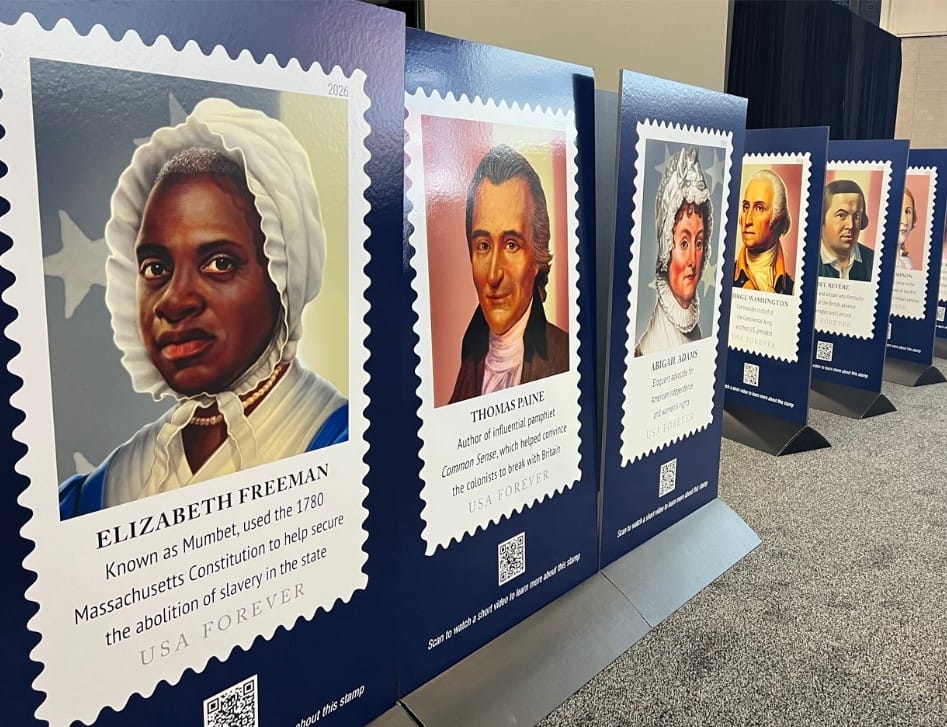
The new U.S. stamps unveiled in Boston over the past week were products of that ordinary CSAC process described in detail by Bobb-Semple: deliberative, pluralistic, and rich with meaning. The capstone “Figures of the Revolution” series issued this week honors twenty-five founding-era notables of varied race, gender, and background, including enslaved people and Native Americans, and feature portraits painted by fifteen artists, some of whom are immigrants.
Other new stamps revealed this week honor the restoration from near-extinction of the American bison—issued just days after the administration revoked some bison-grazing permits on public land in Montana—and Postcrossing, an international postcard-exchange project that builds community and cultural connections across borders, a noteworthy commemoration at a time when immigration and travel have been severely restricted.
Whether a Trump stamp—or one featuring Taylor Swift’s wedding—would help the Postal Service sell more postage, and, in the process, diminish the prestige of its commemorative-stamp program, is unknown. But the collectors I spoke with at the expo seemed broadly skeptical of honoring any living person. They were also protective of CSAC’s process and the expertise and commitment of its members, many of whom are considered philatelic royalty.
Cheryl Ganz, a former CSAC member who also served as chief curator of philately at the Smithsonian National Postal Museum, told me that the committee had discussed putting living people on stamps “repeatedly” during her twelve years as a member. But politicians, she said, were never considered. “They can be honored only for their career outside of politics,” she said.
The public, meanwhile, was recently invited to think about stamps and their meaning. As part of its “Stamp Encore” campaign, the Postal Service asked Americans to vote for a favorite stamp to reprint. The winner, by what the U.S.P.S. said was a wide margin, was the 2018 commemorative honoring Fred Rogers of “Mister Rogers’ Neighborhood”—a man remembered for his kindness, decency, and radical acceptance of people and their differences.
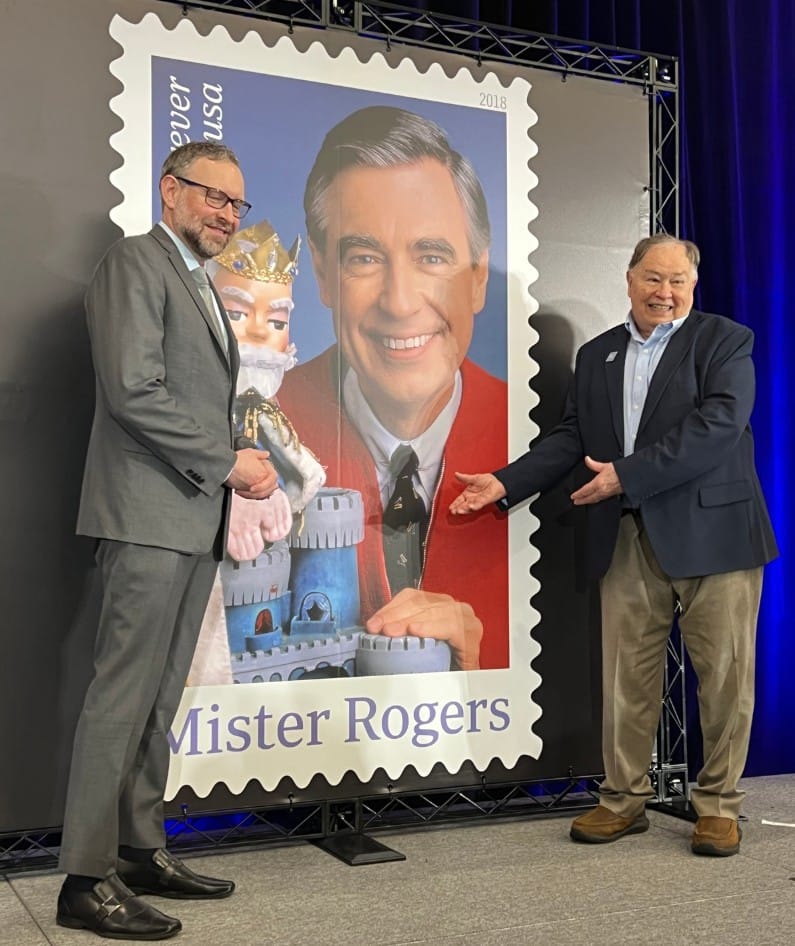
It was not a referendum on living people on stamps, or on the presidency or person of Donald Trump. But it was a reminder that stamps are still small declarations of public meaning, miniature civic portraits of what the country chooses to honor, preserve, and send out into the world.
A Trump stamp, if forced into being by presidential vanity and administrative fiat, would represent something else: not a country reflected back on itself, but more evidence of a president who insists that the country reflect him.
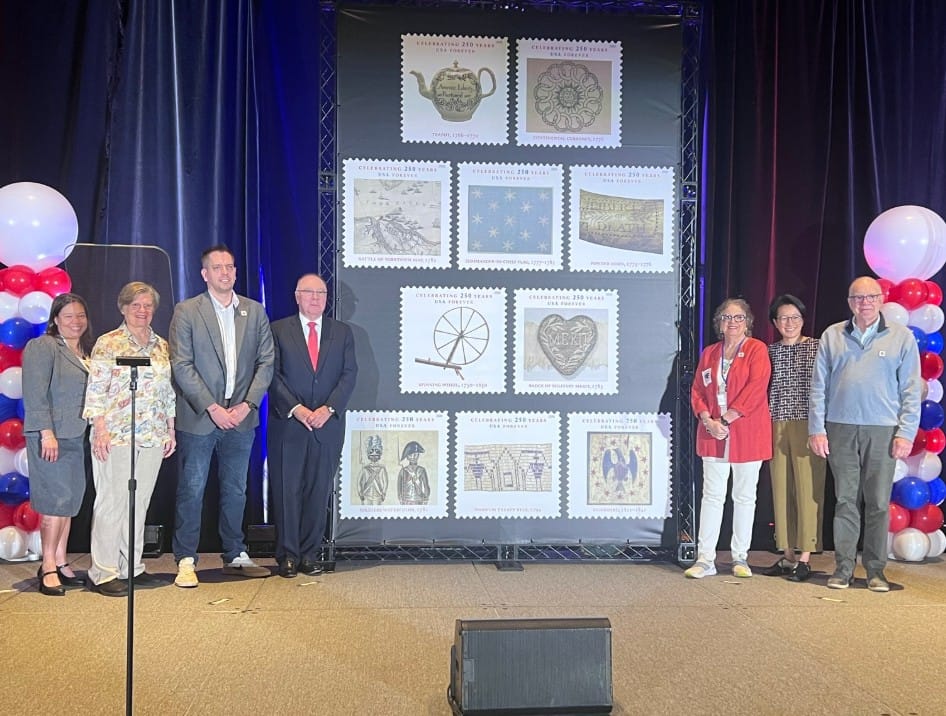
Steiner, for his part, closed his remarks about new “Treasures of the Revolution” stamps with words that suggested, perhaps, that no policy change was needed after all. “The[se] stamps convey that the American story is not distant, rather it is human and it’s evolving and it still speaks to us today,” he said.
In other words, the citizens’ panel went through a rigorous process of thoughtful curation to settle on stamps that powerfully link the past to the present, with no living people or presidents required. Or—more notably in this moment—imposed.


