

A little after five o’clock on Tuesday afternoon—dusk, rush hour, headlights and taillights blurring into the deepening blue-black sky—a seventy-year-old Great Barrington man stepped into the crosswalk on South Main Street near Reed Street, across from a veterinary clinic and a law-firm office.
Moments later, he was struck by a southbound Ford F-250 pickup truck driven by a twenty-four-year-old Connecticut resident; police said the driver was not under the influence.
The injured pedestrian, who people familiar with his living situation said resides at Brookside Manor—the low-slung brick apartments that house income-qualified seniors and people with disabilities—was taken to Fairview Hospital and then airlifted to Baystate Medical Center in Springfield in serious condition, police said.
People familiar with his condition said the man, a Great Barrington resident for the last twenty-six years, remains in critical but stable condition.
The location was not an obscure one. The crosswalk sits along a stretch of Route 7 south of downtown where sidewalks simply end, traffic speeds increase, and people on foot—some elderly and relying on wheelchairs or other assistive devices, as well as parents pushing strollers—regularly travel along the road shoulder to reach nearby amenities like grocery stores, medical offices, pharmacies, and bus stops.
By Thursday evening, the motion-activated crosswalk lights were working. They were also repaired three weeks ago, police said. (Bill Shein/RGM Dispatch)
According to Adam Carlotto, the longtime Great Barrington police officer who earlier this month became the town’s interim police chief, the crosswalk’s warning lights, which rely on motion sensors rather than a pedestrian push-button, were not functioning at the time of the accident. They had been repaired roughly three weeks earlier, he said, before becoming nonfunctional again.
“That’s been a problem intersection for us,” Carlotto told me.
Workers were seen at the signals Thursday morning; by evening, the lights were operating. A “Yield to Pedestrians” sign had also been placed in the roadway.
On Friday morning, an officer from the Massachusetts State Police crash-reconstruction unit was at the scene, measuring distances and marking the pavement as part of a joint investigation with local police. The work so far, Carlotto said, is “preliminary.”
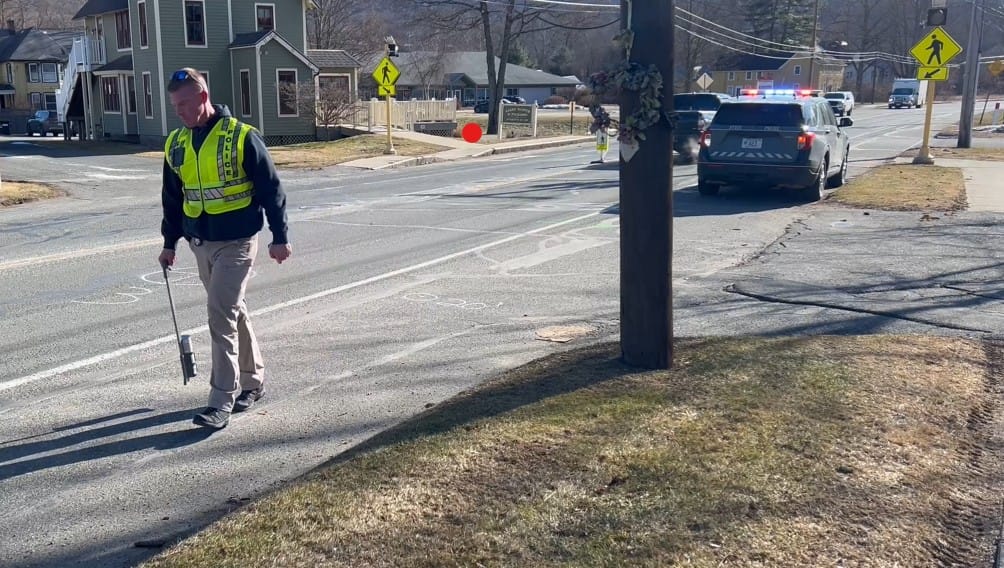
For people who work in nearby stores, several of whom I spoke with this week, news of the accident came as no surprise. The crosswalk’s minimal markings and the intermittent failure of its warning lights have been a recurring problem for years. Even when the lights function, visibility at dusk can be poor, particularly when large vehicles block sightlines near the crossing, which is at a point where southbound traffic accelerates toward a stretch of Route 7 where the speed limit rises to fifty-five miles per hour.
Late Friday afternoon, at roughly the same time as Tuesday’s crash, I went to the crossing and triggered the motion-activated warning lights on each side of the street. Even as the lights flashed slowly—about once every second and a half—cars continued through the crosswalk in both directions without slowing or stopping. It was easy to see how out-of-town drivers, in particular, might mistake the flashing lights for a traffic-calming feature rather than a signal that a pedestrian was crossing.
This stretch of South Main Street was the subject of my in-depth reporting two years ago, which documented how the neighborhood’s seniors and other residents routinely walk—or roll—along the shoulder because sidewalks and crosswalks do not fully connect this section of town.
Elderly residents from Bostwick Gardens, an income-restricted housing complex on South Main Street, crossing Route 7 in January 2024. (Bill Shein/RGM Dispatch)
While reporting that story, one afternoon I tested the crosswalk equipment by standing directly in front of the motion sensors. The lights did not activate.
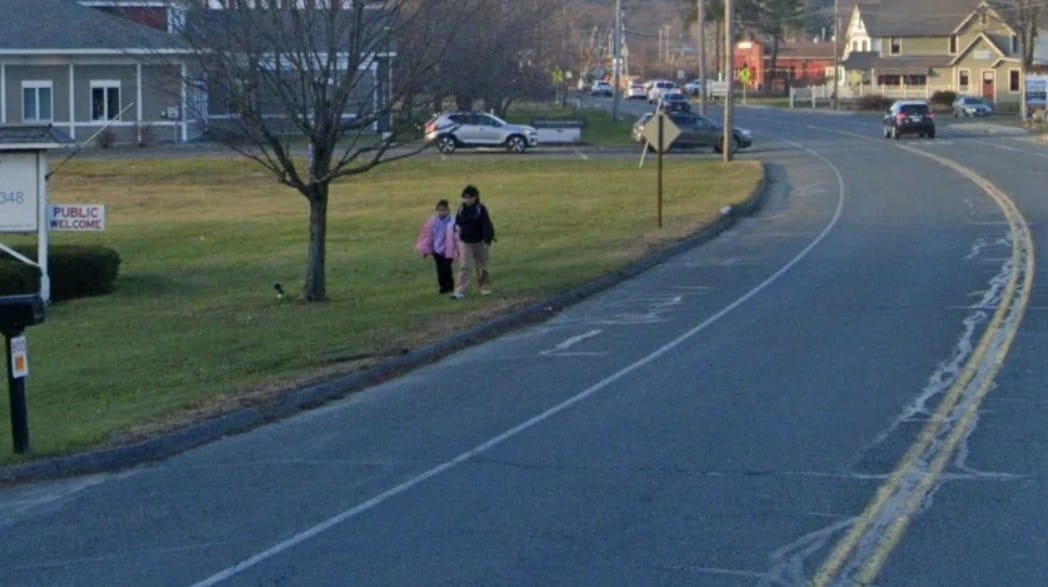
Residents I spoke to at the time described speeding traffic, near-misses, and the daily calculation required to cross Route 7 safely. I also found Google Street View images that showed two backpack-laden children walking along the grass where a sidewalk should be.
One resident of Windrush Commons, an income-restricted housing development that opened in 2023, told me that most people understood the danger. But, she said, people—grateful for affordable housing—tend to shrug, adapt, and not complain about something they assume is out of their control.
 Bill Shein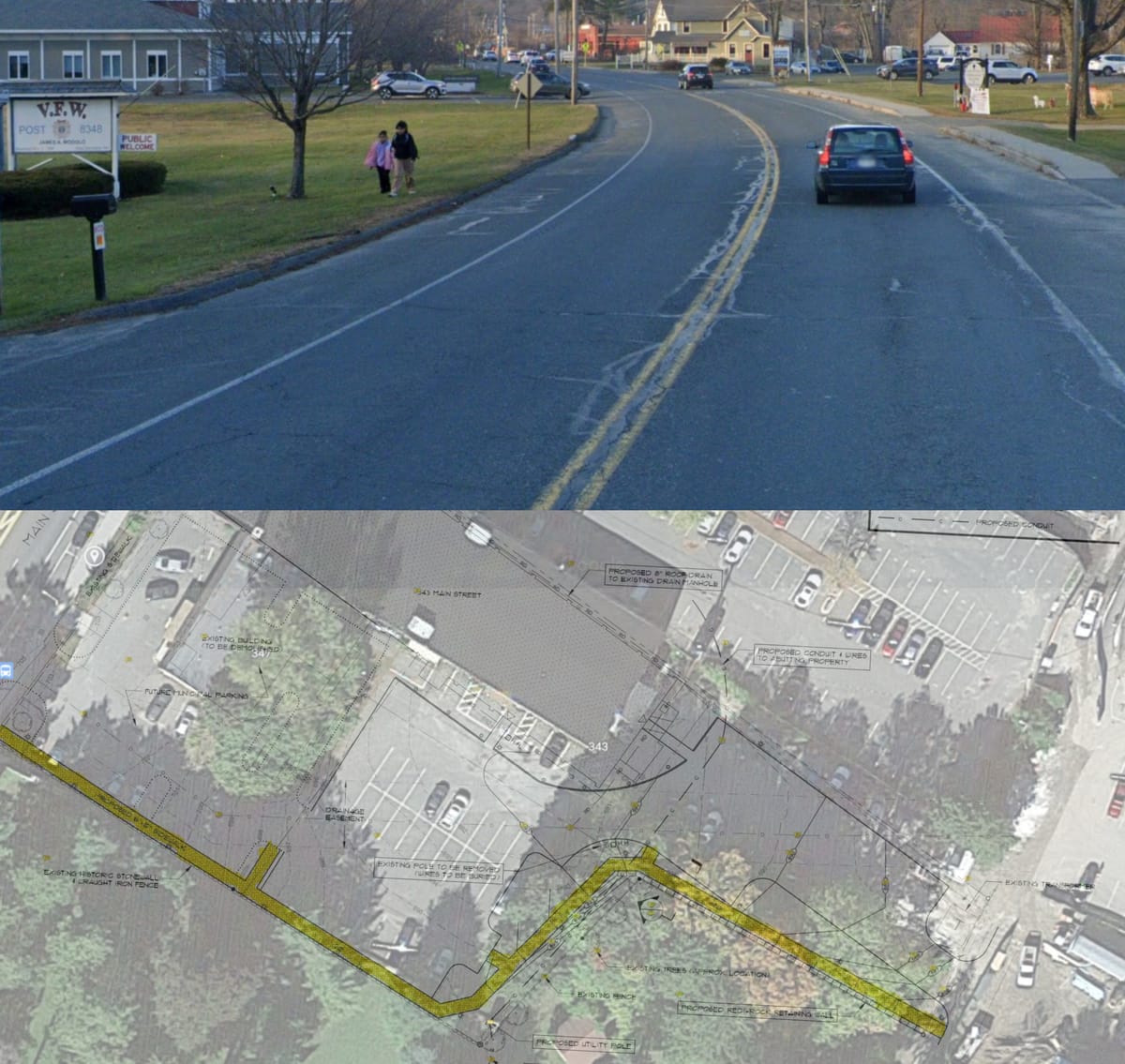
Town records, some acquired through public-records requests over several years, show that officials have long recognized the need to address these issues.
In late 2017, a former public-works superintendent, Sean Van Deusen, initiated a comprehensive $7 million South Main redevelopment plan, which was placed in the county’s Transportation Improvement Program queue—a multi-year bureaucratic process that can unlock federal highway funding and often cover most construction costs.
Advancing that extensive proposal required the town to pay for engineering and design work that would meet state standards. But the town decided not to fund it. And in the years that followed, officials repeatedly declined to commit local capital dollars, and other state funding did not materialize.
While reporting on South Main Street issues in early 2024, I tested the crosswalk traffic signal. The day I was there, it did not work. (Bill Shein/RGM Dispatch)
In an unsuccessful 2024 state grant application that sought nearly five million dollars for roadway, sidewalk, and crosswalk improvements along South Main, the town described the work as “critical to SAFELY [sic] connecting” housing, services, and businesses.
The application included the Street View images of children presented in my reporting. A support letter from the director of the town’s Council on Aging, which oversees the Claire Teague Senior Center located on South Main, cited seniors’ concerns about crossing the roadway safely to reach those grocery stores and medical offices. “The project will add new sidewalks on both sides of the street, as well as new safe crosswalks and bike lanes,” the letter noted.
In early 2024, the budget proposed by then-Town Manager Mark Pruhenski included $3.5 million for South Main improvements recommended by the town's new supervisor of public works, Joe Aberdale. But the elected Finance Committee and Select Board removed the line item, hoping that grant funding would eventually cover the cost.
Throughout this period, the town secured funding and made appropriations for many other infrastructure projects. It applied for, and won, a nearly $600,000 state grant for repairs to West Sheffield Road—home to expensive properties and the members-only Wyantenuck Country Club. It also allocated funds for more than three thousand feet of new sidewalk in a desirable neighborhood known as “The Hill,” near Fairview Hospital.
In late 2023, Great Barrington also received a one-million-dollar MassWorks municipal grant after Rembold told state officials it would fund a downtown “pedestrian walkway” that he suggested would be “an important connector for residents and visitors.” But the project ultimately amounted to aesthetic and infrastructure improvements largely to benefit a private development that offers luxury apartments at nearly $3,000 per month.
The crosswalk on Friday evening. (Bill Shein/RGM Dispatch)
All the while, elected officials were well aware of complaints about crosswalks. In 2022, the Select Board voted to install high-visibility crosswalks with modern pedestrian signals in the increasingly upscale downtown core. But no funding was allocated for similar upgrades to South Main Street, near the town’s senior and income-qualified housing.
On Friday afternoon, I sent this reporting and written questions to Liz Hartsgrove, who became Great Barrington’s town manager in November, and left a voicemail requesting comment. Early Saturday morning, she said she would respond, but no reply was received before publication.
Steve Bannon, the chair of the Select Board since 2018 and a member since 2010, did not respond to a request for comment on Saturday.
In the wake of Tuesday's accident, what remains unclear is not whether the danger was known, but why even modest, obvious fixes—new sidewalk connections, clearer markings, better lighting, and modern and functional crosswalk signals—were not implemented, even as many other projects moved ahead.
Correction: This story has been updated to reflect that a Great Barrington town-budget proposal to fund South Main Street improvements was made in early 2024, not early 2025 as initially reported.


