

Happy Valentine’s Day, everyone. May your day be filled with love, affection, and as much candy as you can possibly stuff into your mouth at one time.
Today’s newsletter is brought to you by America’s Dentists™, proud silent partners in the Valentine’s Day chocolate-industrial complex. Don’t brush!
This edition of The RGM Dispatch provides updates to recent reporting with a look at two vastly different streams of federal spending flowing into Massachusetts.
One is relatively small, headed toward new and upgraded crosswalk signals in Great Barrington—part of a broader state and federal effort to reduce pedestrian deaths, which have skyrocketed over the past decade.
The other, far larger, is flowing to a set of Massachusetts companies—including Pittsfield’s Lenco Industries—through new ICE spending since last January in service of President Donald Trump’s mass-deportation campaign.
∎ Signals on South Main ∎
At long last, modern push-button crosswalk systems are coming to five locations in Great Barrington—including the site of a fatal accident last month on South Main Street.
As I reported, the aging crosswalk lights at the intersection with South Reed Street were not functioning at the time of that crash. In the wake of the accident, which killed longtime Great Barrington resident Gary Fretwell, the town’s new manager, Liz Hartsgrove, told the Select Board she would recommend installing new crosswalk equipment there.
As it turns out, plans for replacement were already underway. According to the Massachusetts Department of Transportation, in October 2024, Joe Aberdale—the town’s public-works supervisor, who came out of retirement for the job—applied to a MassDOT materials-procurement program that provides modern Rectangular Rapid Flashing Beacon (R.R.F.B.) crosswalk assemblies to communities across the Commonwealth at no cost.
Last August, the state awarded five of them to Great Barrington.
According to MassDOT spokesperson John Goggin, each of the new units costs $13,250, for a total award of $66,250—a relatively modest per-assembly sum that may lead many to ask why the town didn’t replace the outdated South Reed equipment, which was installed in 2007, much sooner.
(A May 2025 engineering study prepared for the town described it as “an older style” of crosswalk-warning light.)
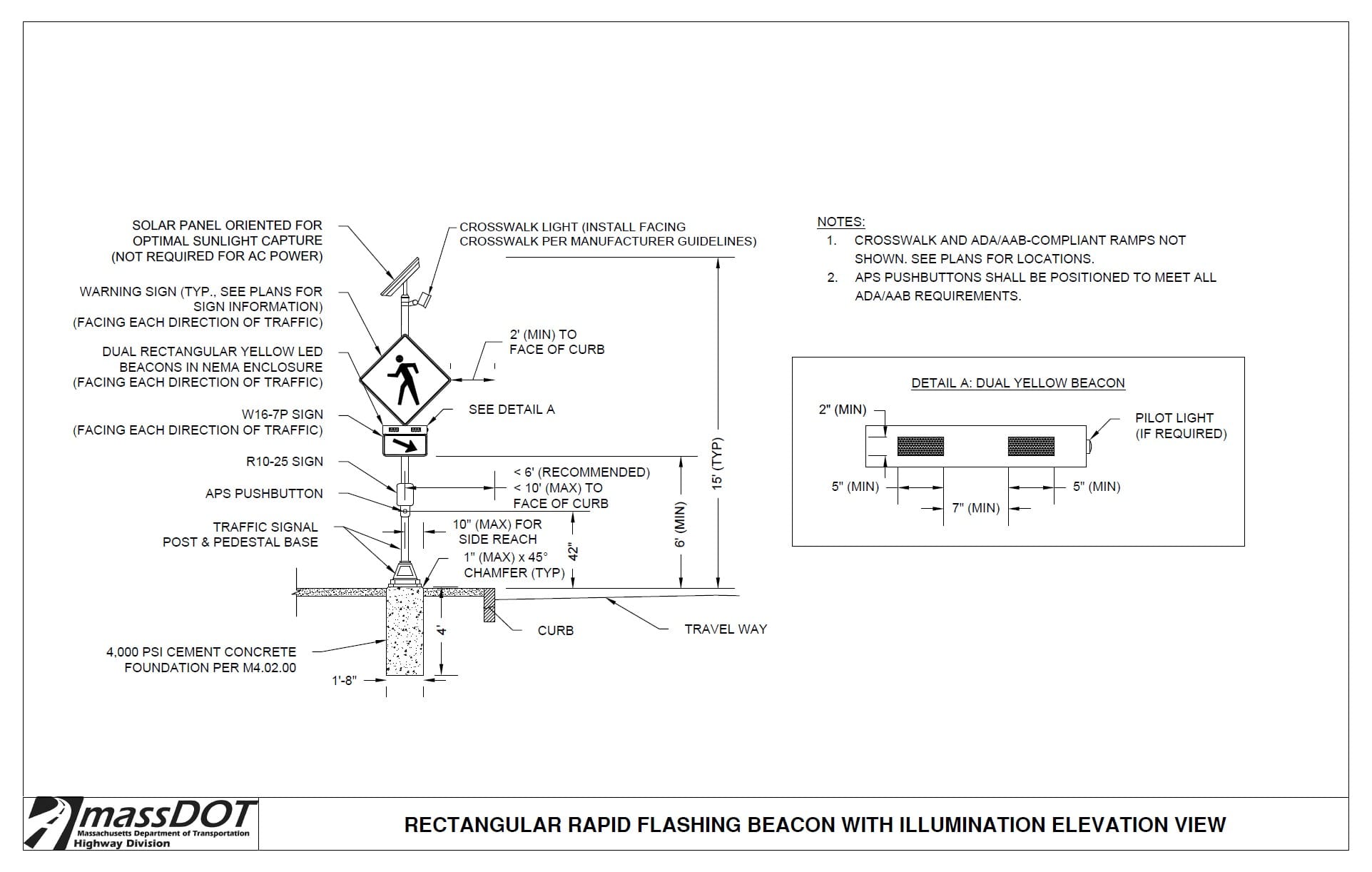
The state has paid for the hardware, which Goggin said will be delivered in April. Installation must be completed at the town’s expense within ninety days of receipt.
Aberdale told me his recent budget request includes $111,000 to cover installation costs at all five locations. Hartsgrove’s proposed FY27 budget includes $171,000 for crosswalk improvements. The accompanying narrative provided to the town’s Select Board and Finance Committee on Friday says that funding crosswalk installation and replacement “supports safe mobility and reduces liability exposure”—a phrase that may take on added weight in the wake of the crash.
 Bill Shein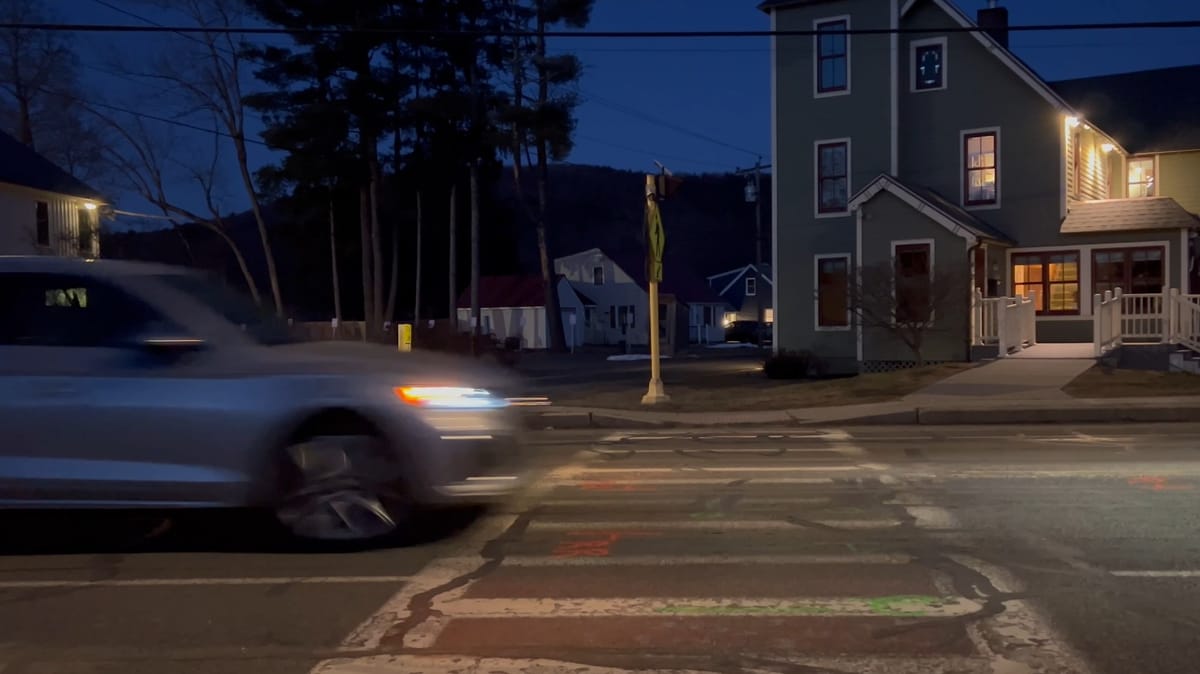
The other four sites will get crosswalk lights where none currently exist. (For locals: Pleasant Street at Front Street (Route 183); North Plain Road (Route 41) at Main Street; Bridge Street at the Riverfront Trail; and Main Street (Route 7) at Rosseter Street.)
All of the assemblies include overhead lighting that can illuminate the crosswalk when activated at night.
The upgrade at South Main comes none too soon. Even though the existing crosswalk lights have since been repaired, on certain sunny winter mornings—during the first half-hour after sunrise—they begin flashing as if summoned by an invisible pedestrian. No one is waiting to cross, and cars pass through without slowing. The yellow lights flash continuously—a pattern that traffic engineers warn can condition drivers to treat the signal as background noise rather than a warning tied to pedestrians.
In videos I recorded on several mornings this month, the south-facing motion sensor sits at the top of the pole, angled toward the crossing—and directly into the rising sun and at shadows cast across the pavement. (On cloudy mornings, the lights were not affected by sun or shadows during that just-after-sunrise period and appeared to work as expected.)
Video captured earlier this month shows the South Main Street crosswalk lights flashing without pedestrians nearby. (Bill Shein/RGM Dispatch)
Aberdale confirmed that crosswalk lights that rely on motion sensors can be triggered by shadows or shifting light. “We occasionally see that during certain times of the year or day,” he told me in an e-mail this week.
Mike Knodler, director of the UMass Transportation Center, agreed that activations could be caused by light and shadows—or perhaps sunlight reflecting off snow, which has remained on the ground since a large mid-January storm. In terms of pedestrian safety, it’s not ideal. “We never want to show activation in the absence of actual pedestrians,” he said, “as it lessens the longer-term efficacy.”
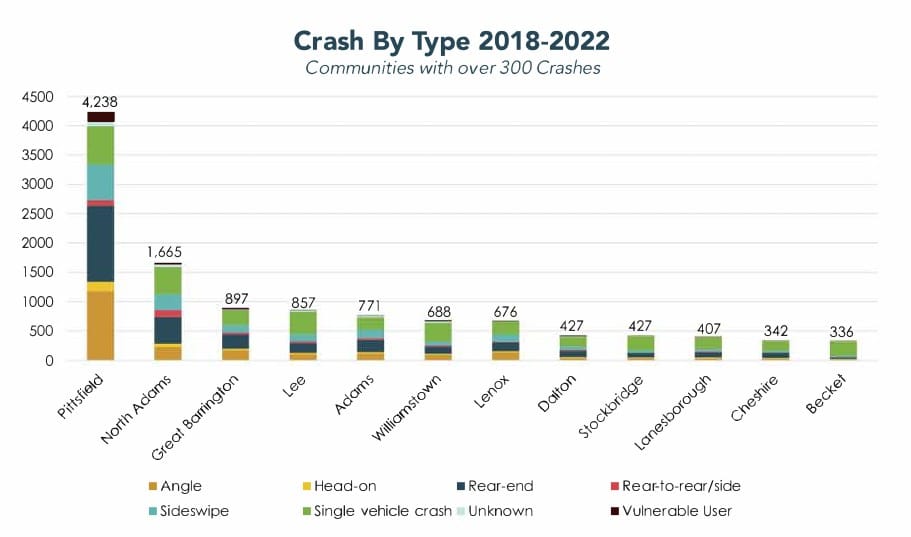
The crosswalk sits in a town that data suggest needs more investment in roadway safety. According to the Berkshire Regional Planning Commission’s 2024 Safe Streets for All “STEPS” Action Plan, Great Barrington ranks among the highest in the county for serious and fatal crashes per roadway mile—a measure that adjusts for roadway length and traffic volume. Countywide, between 2018 and 2022, twenty per cent of fatal and serious crashes involved someone walking or biking. After earlier declines, crash severity in Berkshire County has been rising again since around 2018.
The local trend mirrors a national one. Federal data show that more than 7,300 pedestrians were killed in traffic crashes in the United States in 2023, representing nearly one in five traffic fatalities. Pedestrian deaths remain twenty per cent higher than in 2016 and have climbed nearly eighty per cent since 2009, according to the Governors Highway Safety Association.
In response, transportation agencies often turn to low-cost, rapidly deployed improvements like R.R.F.B. systems. Federal research associates the beacons with dramatic increases in driver-yielding—sometimes exceeding ninety percent—and meaningful reductions in pedestrian-involved crashes at crossings.
As I’ve reported previously (here and here and here), a broader overhaul of more than a mile of South Main Street, which is home to a concentration of income-qualified housing for seniors and families, has been proposed and deferred for nearly a decade. A 2017 proposal, estimated back then at more than seven million dollars, would have included new and repaired sidewalks, additional and upgraded crosswalks, roadway improvements, and traffic-calming measures experts say are needed along a corridor where traffic moves at speed into and out of town past residential housing.
In early 2024, as part of his FY25 budget request, Aberdale sought $3.5 million for improvements along much of the corridor. The proposal was stripped from the budget by the Select Board and Finance Committee, amid suggestions that state grant funding might cover the work. It did not: a June 2024 application seeking nearly five million dollars from the state was unsuccessful. (In a story last month, I misstated the timeline of that proposal; it has since been corrected.)
Goggin said pedestrian safety is an agency priority. “MassDOT is actively trying to reduce pedestrian fatalities and injuries,” he told me this week, pointing to a 2023 state assessment of risks to vulnerable road users. “Providing quick-turnaround materials [like R.R.F.B.’s] to help communities reduce fatalities—while concurrently working on longer-term safety projects—is part of our implementation plan,” he said.
Funding for the town’s new crosswalks flowed through the federal Highway Safety Improvement Program, which received a boost under the Biden-era Bipartisan Infrastructure Law, passed by Congress in November 2021 and directing more funds to safety improvements for vulnerable road users. The H.S.I.P. program traces its roots to a federal law whose acronym is longer than most crosswalks: the Safe, Accountable, Flexible, Efficient Transportation Equity Act: A Legacy for Users—mercifully, if awkwardly, abbreviated as SAFETEA-LU.
If this kind of reporting matters to you, consider upgrading to paid membership. Reader support lets me keep digging long after others have stopped asking questions.
Hartsgrove told the Select Board last month that she would also seek grant funding to pay for lighting and sidewalk improvements near the Brookside Manor senior-housing apartments, where Fretwell lived for a year before his death. What happens if those grants do not come through remains unclear. “Details have yet to be determined, and it is all pending the FY27 budget process,” she told me this week.
Also up in the air is any plan for a new sidewalk to finally connect Windrush Commons—which opened to one hundred fifty residents in 2023—to the rest of town. For now, residents continue to walk and roll on nearby grass or along the shoulder of Route 7, close to passing traffic, if they want to reach a grocery store or bus stop. At present, with snow piled high, the shoulder is the only option.
∎ More details on ICE spending in Massachusetts ∎
While federal safety dollars flow into crosswalks, another stream of federal spending is moving in a very different direction.
As I wrote earlier this month, since January 20, 2025, U.S. Immigration and Customs Enforcement has obligated new funds to nineteen Massachusetts companies—including Pittsfield-based Lenco Industries—for equipment and services.
Lenco, whose BearCat armored vehicles have been used in ICE raids (including in Great Barrington), during crackdowns on protestors, and featured prominently in Department of Homeland Security hype videos, received more than five million dollars in new ICE spending, the most among Massachusetts-based companies.
 Bill Shein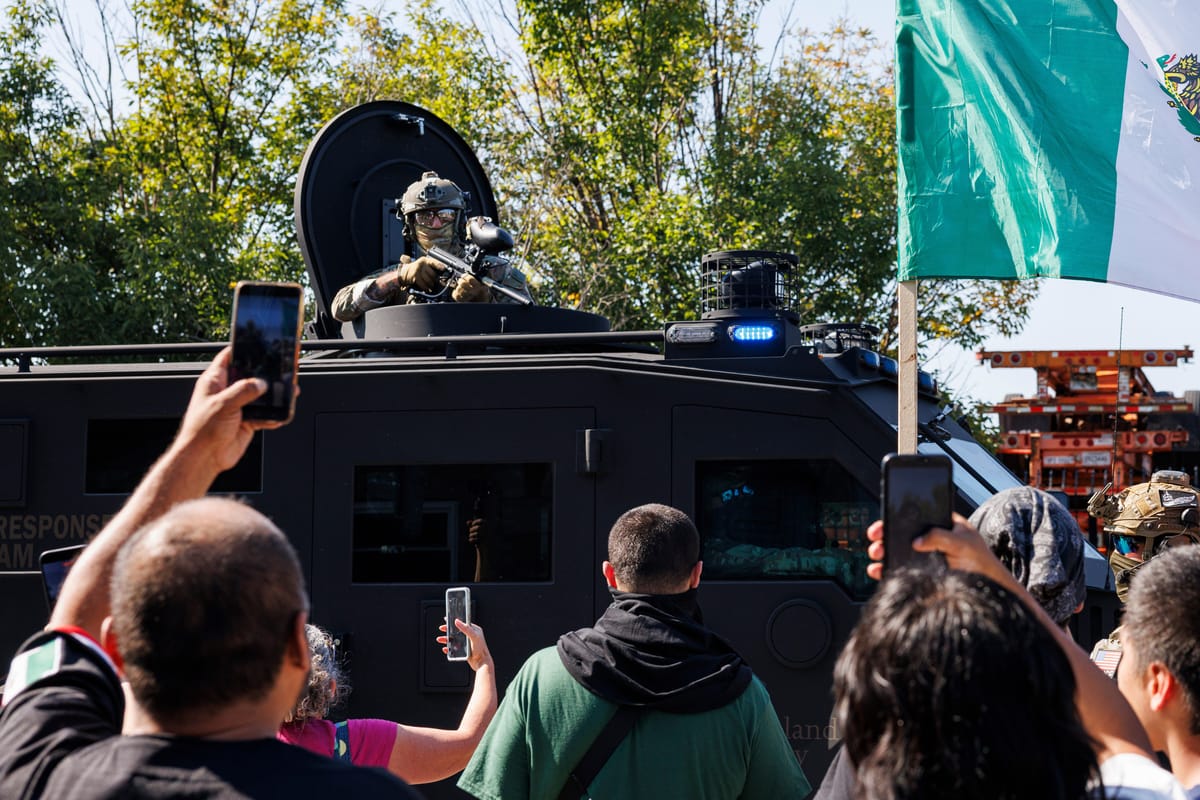
In total, ICE obligated nearly twenty million dollars of new spending to Massachusetts companies in the first year of the mass-deportation campaign.
That story included a chart showing the top five recipients. The chart below expands the view to examine where all the money is going and what it’s buying. It was compiled using the same federal procurement database but with a closer look at contract descriptions.
That’s where additional details emerge: a first-time federal contract worth $4.6 million for Plymouth-based BI2 Technologies, which provides iris-scanning technology and biometric databases used—alongside ICE’s facial-recognition systems—to identify individuals; $1.5 million for badges and shields from V.H. Blackinton in Attleboro Falls; and nearly $30,000 for “leg irons and handcuffs” sold by Veterans Business Supply in Stoneham.
New ICE Contract Obligations (Massachusetts)
Awards Issued Jan 20, 2025 – Jan 20, 2026
Total: $19.6 million
Lenco Industries (Pittsfield) — $5,207,841
BearCat armored vehicles + repair parts
BI2 Technologies (Plymouth) — $4,575,000
Iris/biometric recognition technology
Lionbridge (Waltham) — $3,897,211
Translation, interpretation & transcription (24/7 legal)
eClinicalWorks (Westborough) — $2,273,286
Electronic health record platform for detention facilities
Chevin Fleet (Fitchburg) — $1,588,388
Fleet management software & services
V.H. Blackinton (Attleboro Falls) — $1,437,230
Law-enforcement badges & shields
Crosstown Courier (Chicopee) — $197,117
Courier services
O2X Human Performance (Scituate) — $99,748
Agent readiness & resilience training
Thermo Scientific (Wilmington) — $71,039
Handheld narcotics & chemical analyzers
Collabware (Cambridge) — $50,400
Electronic records management software
Source Code (Norwood) — $38,925
Evidence data storage server
American Alarm (Arlington) — $34,616
Security monitoring installation & maintenance
Formlabs (Somerville) — $29,923
3D printer for forensic investigations
Bulfinch Unit A (Boston) — $29,125
Parking for Homeland Security Investigations agents
Veterans Business Supply (Stoneham) — $28,371
Leg irons & handcuffs
Minuteman Security (Andover) — $23,437
Security system maintenance
On Target Firearms (Dracut) — $12,500
Indoor firearms range rental
RaySecur (Cambridge) — $8,156
Mail screening services
Leidos Security (Woburn) — $8,000
Baggage X-ray servicing
One more follow-up: In that story, which asked local, state, and federal elected officials who have sharply criticized ICE whether Lenco and other Massachusetts-based companies should suspend sales to ICE, Tricia Farley-Bouvier—who represents Pittsfield in the state legislature—told me that she needed to learn more before taking a position. (Last March, Farley-Bouvier compared ICE activity in Pittsfield to the Holocaust.)
My interview with Farley-Bouvier was on January 20. I reached out to her office this week to ask whether she has since reached a decision but did not receive a response. As always, I’ll continue to follow up and keep you posted.
∎ “On the Radio — Whoa Oh Oh” (But Not a Love Song) ∎
Finally, here’s a nine-minute conversation I had this week with WAMC’s Josh Landes about the Lenco story. And yes, while “I said it on the air,” I didn’t say it “really loud.” (Apologies to Donna Summer.)
 Josh Landes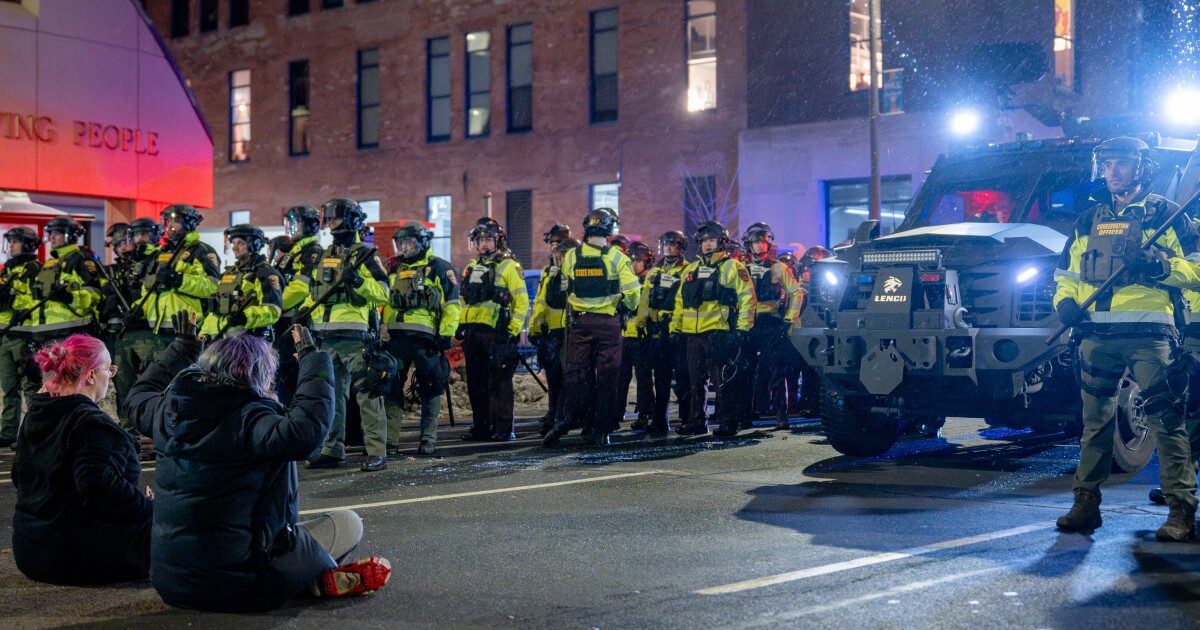
Please keep in touch with news tips, upcoming winning lottery numbers, or just to ask if America’s Dentists™ is a real thing.
Until next time,
Bill
Correction: Shortly after publication, this story was updated to add clarity to the description of how crosswalk lights at South Main Street are affected by early morning sunlight.


